



The assassination of Charlie Kirk is a grim milestone in a trend we’ve been documenting for a while: the normalization of political violence. Kirk devoted his career to debate – the very practice at the heart of civic life. And in that sense he was a living embodiment of the democratic virtue that differences are to be argued, not avenged.
In the days following this horrific act, my team at Sachs Media surveyed 1,350 Florida voters. Our goal was to take a pulse on how people are processing the rise of political violence and to provide context for what appears to be a growing willingness by many to embrace or justify bloodshed in the political arena.
The results are sobering:
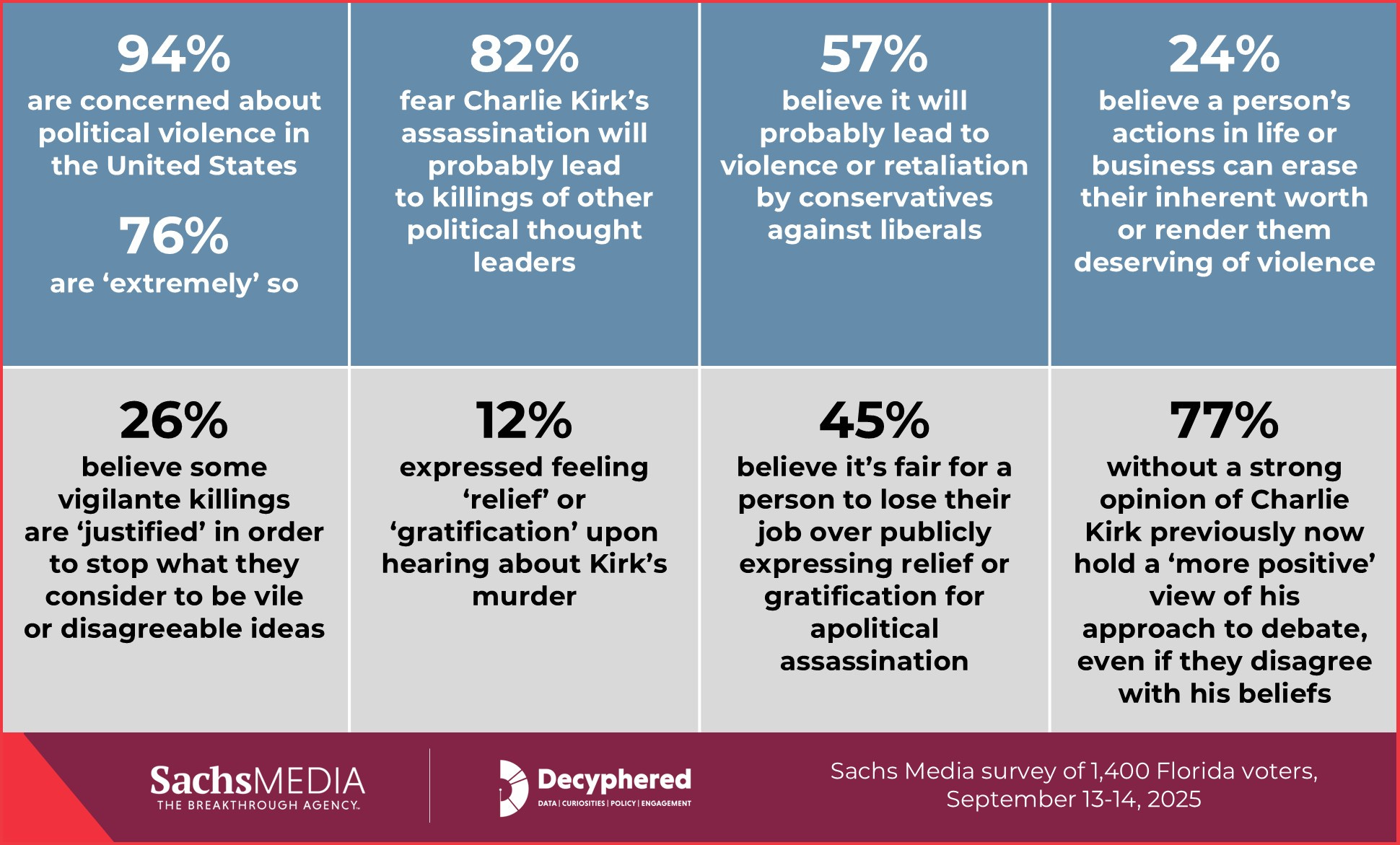
Nearly everyone (94%) is concerned about political violence in the United States, including 76% who describe themselves as extremely concerned, with this worry expressed by equal shares of people across parties and age groups.
82% believe Charlie Kirk’s assassination will probably lead to copycat killings of other political thought leaders, with no differences between parties.
Well more than half, 57%, believe the killing will probably lead to violence or retaliation by conservatives against liberals – a concern expressed by 86% of Democrats, 71% of nonpartisans, and 24% of Republicans.
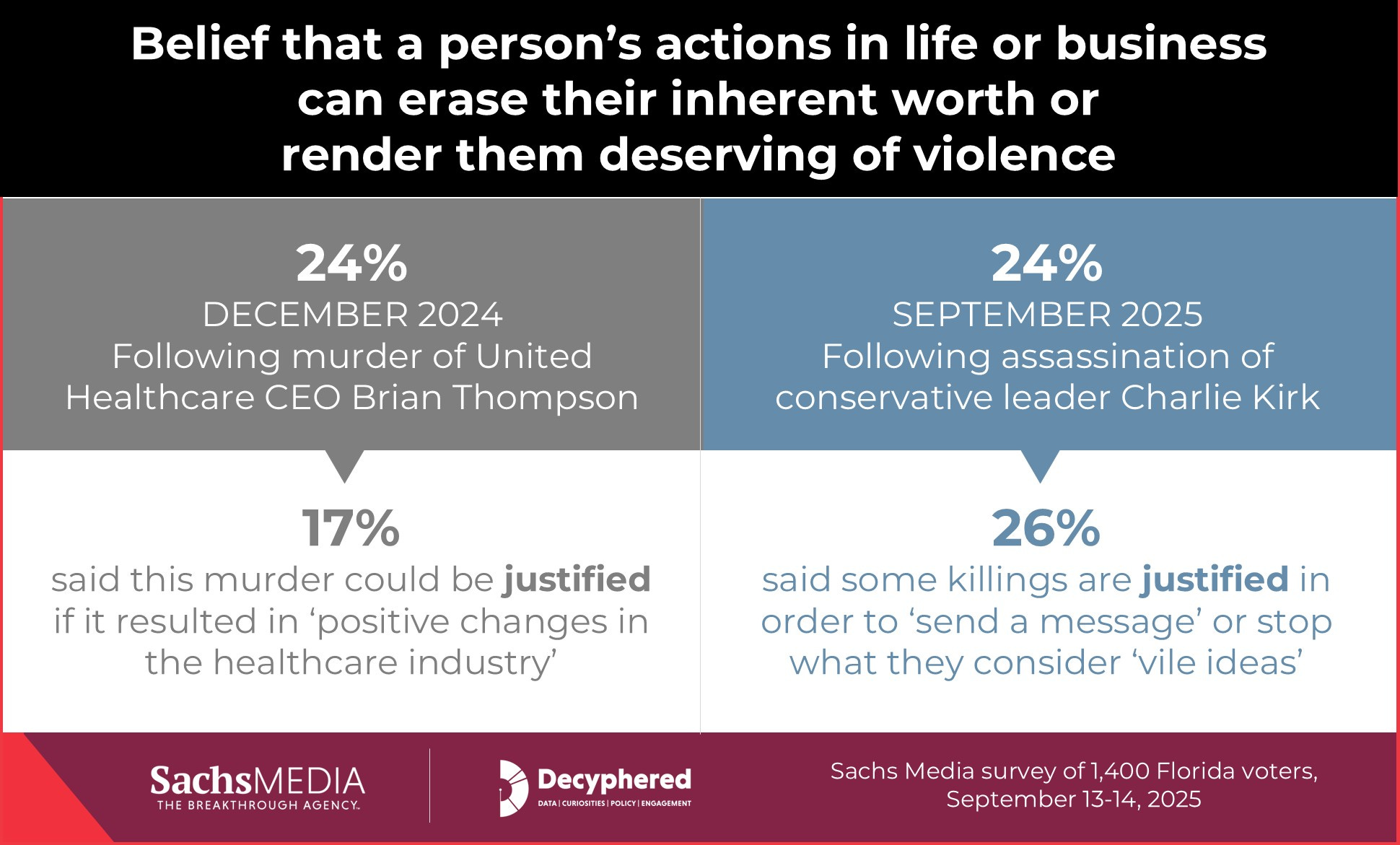
24% believe a person’s actions in life or business can erase their inherent worth or render them deserving of violence. This includes 33% of those younger than 45 and 20% of those older.
About the same portion, 26%, believe some vigilante killings are “justified” in order to “send a message” or stop what they consider to be the spread of vile ideas – with the age spread consistent with responses to the prior question.
One in 8 (12%) said they felt gratification or relief upon hearing about Kirk’s murder, predictably divided sharply across partisan lines.
Voters are divided on whether it’s fair (45%) or unfair (55%) for a person to lose their job for expressing relief or gratification about Charlie Kirk’s death.
Among those who didn’t have a strong opinion of Charlie Kirk before his assassination, more than 3 in 4 (77%) said they now hold a more positive view of his approach to debate than they previously did – regardless of whether they agree with his specific views. This more favorable opinion of Kirk’s approach to debate was expressed by 51% of Democrats, 69% of nonpartisans, and 91% of Republicans.
This isn’t the first time we’ve measured attitudes about political violence. Immediately after the December 2024 murder of UnitedHealthcare CEO Brian Thompson, I was stunned by the abundance of celebrations of this act on social media, including the glamorization of and support for his accused killer, Luigi Mangione.
Hoping at that time to find that these gleeful voices really came from a very small (if very loud) corner of the internet, we surveyed Florida voters to learn more. That altruistic hope was quickly dashed: Nearly 1 in 4 (24%) said that “some vigilante killings are deserved” as a person’s “actions in life and business can erase their inherent worth” – a belief expressed by half (50%) of those younger than 45. When the question was asked another way, 17% overall said Thompson’s murder could be justified if good things came of it through reforms to the insurance industry – including 39% of those under 45. These findings were replicated nationally by other pollsters, confirming our methodology and once again illustrating Florida’s utility as a national bellwether.
Nearly half (46%) of those surveyed at that time expressed the concern that Thompson’s murder could inspire copycat killings of others.
Horribly, it did.
In the months that followed, Americans witnessed the February 2025 arson of Pennsylvania Governor Josh Shapiro’s home by a pro-Palestine extremist seeking to terrorize the Jewish leader’s family following their Passover seder; the June 2025 attacks on multiple Democratic political leaders in Minnesota, resulting in the deaths of state legislator Melissa Hortman and her husband Mark; the June murder of two Israeli Embassy staffers in Washington, D.C.; and that same month, a deadly firebombing attack on a group of Colorado residents demonstrating peacefully in solidarity with Israeli hostages still in captivity. These all followed multiple attempts to assassinate President Trump, the horrible attack on Nancy Pelosi’s husband, and more.
It's notable that broad sentiments about the use of extrajudicial violence haven’t changed over the months since our earlier survey. Then and today, 1 in 4 among us find a way to justify (or celebrate) murder as a means of silencing political opponents.
Earlier this week, I challenged a Facebook friend who posted a gloating meme about Kirk’s murder: “Please tell me you’re not celebrating political violence.” The friend replied by invoking various policies he believes constitute comparable “political violence” – including “incarceration in America,” “denying gender affirming care,” “stopping vaccines,” or “National Guard wandering the streets of DC.”
That false equivalence of public policy to actual murder is both hyperbolic and dangerous. Public policy, no matter how much one might personally disagree with it, is enacted through democratic means and implemented by individuals elected or appointed to make such decisions – and must be amended through the same process.
That’s what separates and defines American political culture. Each time we excuse or celebrate violence, we chip away at that foundation.
Thanks for pulling this data together. Out culture is broken
Thank you so much for the work you put in on this. We need safe places to hold debates and people who actually listen to one another.