

Respect and Rejection: Public Split Over Jewish American Heritage Month
Survey finds admiration for contributions — but opposition to honoring Jewish Americans runs more than twice as high as for a concurrent heritage observance

In an important, biting column for Florida Politics, publisher Peter Schorsch warns that this year’s Jewish American Heritage Month “could be the last.”
He points to a serious crisis of extremism emerging on both sides of the political aisle – “from cosplay in keffiyehs to larping with ‘goyim’ tropes” – and cautions that if institutions fail to respond seriously, the dire consequences may arrive before many people even recognize the problem.
Heritage months are a familiar part of the American civic calendar. February recognizes Black history, March recognizes Irish American heritage, April recognizes Arab American heritage, and October includes recognitions for Filipino, Polish, and Italian Americans.
So how do Americans feel about recognizing Jewish Americans in May? And how do those feelings compare with another heritage month recognized at the same time, Asian American and Pacific Islander Heritage Month?
As usual, to get some answers I approached the question through an experiment embedded in a scientific survey of 1,200 Florida voters, fielded May 9-11, 2026. Prior studies have shown Florida to be a strong bellwether for national sentiment.
In this experiment, respondents saw one of four messages about a presidential proclamation honoring either Jewish American Heritage Month or Asian American and Pacific Islander Heritage Month. To reduce the potential effect of responses being influenced by a person’s feelings about the president, half of each treatment group were told President Trump issued the proclamation while the other half were told each of the last five presidential administrations had made the same recognition.
The results reveal something deeper than approval or disapproval of a presidential statement. They point to how voters react to the specific groups being honored.
Overall, nearly identical shares of Florida voters approve of a proclamation honoring the history of Jewish Americans (58%) and Asian Americans (59%). But when it comes to opposition, negative feelings are more than twice as high for Jewish American Heritage Month (14%) as for Asian American and Pacific Islander Heritage Month (6%). The rest are uncertain, at 28% and 35%, respectively.
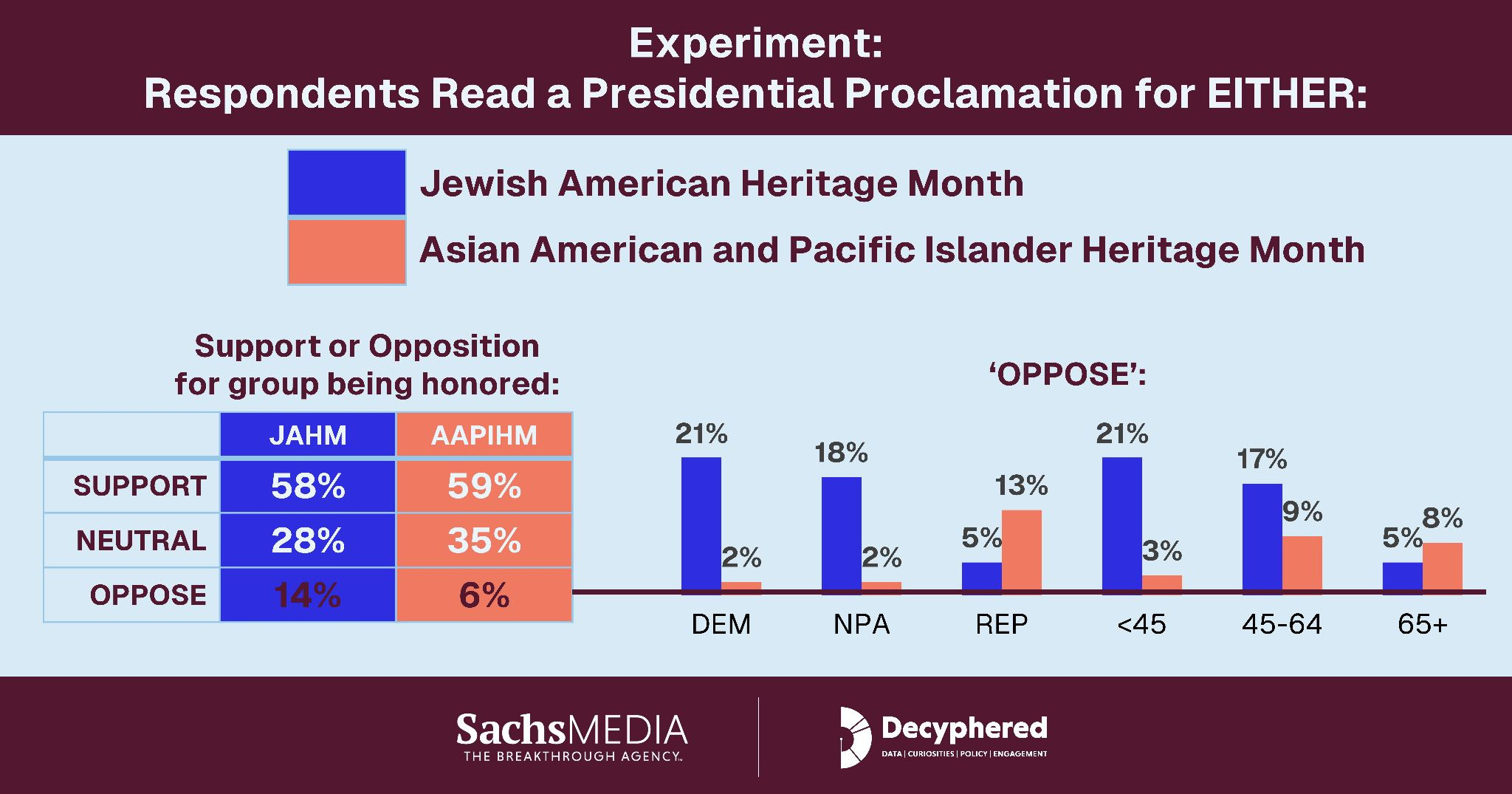
The difference in opposition is especially pronounced among Democrats and nonpartisans. Among Democrats, 21% oppose recognizing Jewish American Heritage Month, compared with just 2% of Democrats who oppose recognizing Asian American and Pacific Islander Heritage Month. Among nonpartisans, the gap is similar: 18% oppose recognition of Jewish Americans compared with 2% who oppose recognition of Asian Americans.
Republicans show the reverse pattern: Just 5% oppose recognizing Jewish American Heritage Month, while 13% oppose recognizing Asian American and Pacific Islander Heritage Month.
Age differences are also striking. Among voters younger than 45, 21% oppose recognizing Jewish American Heritage Month compared with just 3% who oppose recognizing Asian American and Pacific Islander Heritage Month. The divide continues among voters ages 45-64, at 17% and 9%, respectively, before narrowing and reversing slightly among those ages 65 and older, at 8% and 5%.
Significantly, the presidential cue itself did little to change the pattern. Democrats were about as likely to support or oppose Jewish American Heritage Month whether the proclamation was attributed to Trump or to the last five presidential administrations. Republicans were similarly unmoved on Asian American and Pacific Islander Heritage Month, regardless of whether the recognition was framed as coming from Trump or from multiple administrations.
Nobody was asked about Israel or any Asian countries
The experiment did not ask voters how they feel about Israel, the Israeli government, the war in Gaza, or any foreign policy issue. It also did not ask how they feel about the politics or conflicts underway in any Asian or Pacific Island nation.
It asked only whether they approve or disapprove of a presidential proclamation recognizing the heritage and contributions of Jewish Americans or Asian American and Pacific Islanders.
That makes the gap harder to explain away. One of the most common defenses against charges of antisemitism is that opposition to Israel should not be conflated with hostility toward Jews.
But when opposition to recognizing Jewish American history runs more than twice as high as opposition to recognizing Asian American and Pacific Islander history, the finding becomes difficult to explain as anything other than antisemitism, or at minimum, a willingness to hold American Jews accountable for feelings about a Jewish state (which, by definition, is also antisemitism).
How do Americans perceive Jewish American contributions to U.S. History?
To better understand why some support and others oppose recognizing Jewish American Heritage Month, we asked how Floridians view the role of Jewish Americans in U.S. history. Overall, 75% say Jewish Americans have played a generally positive role, while 9% disagree and 16% are unsure.
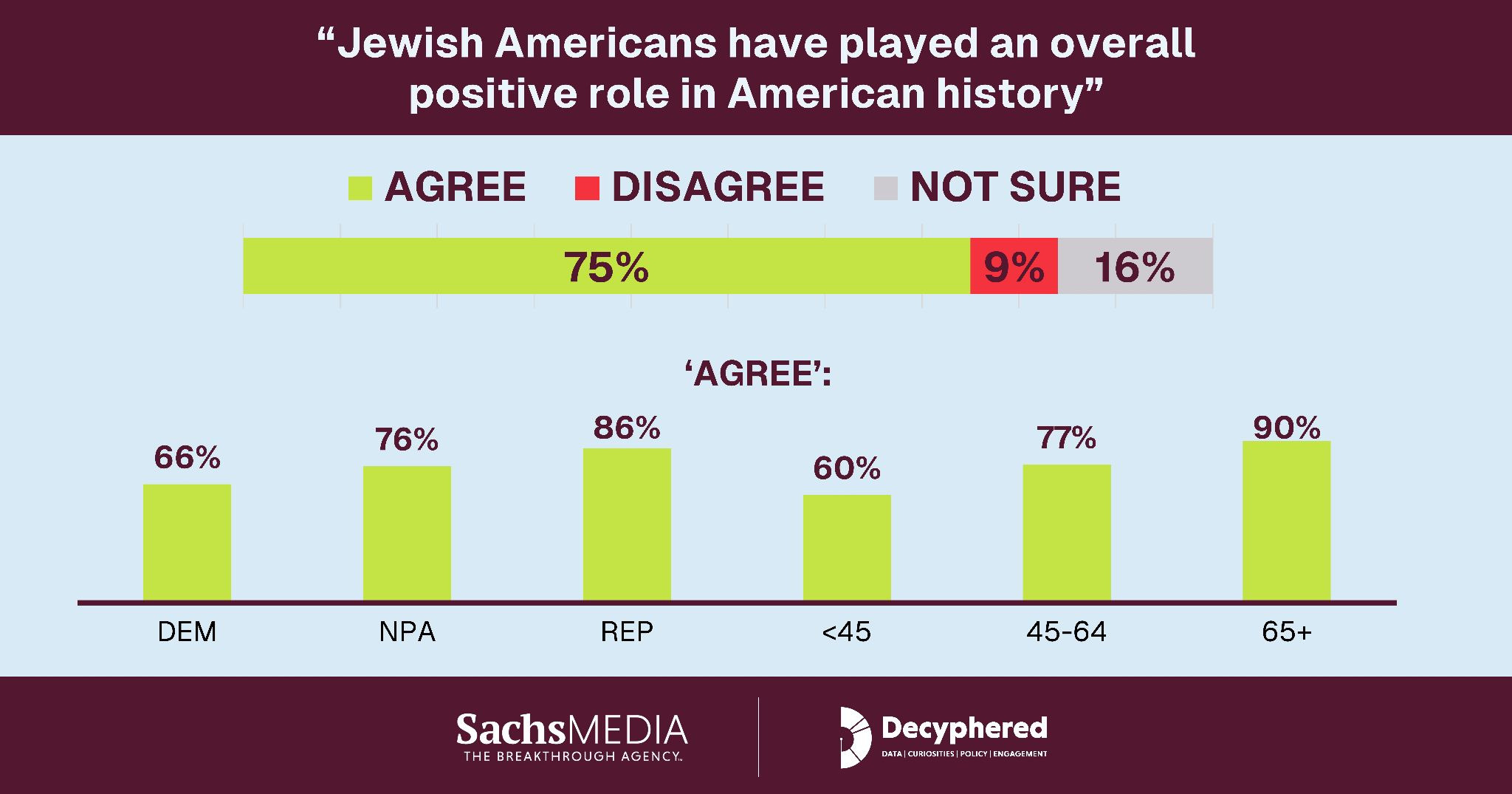
Here again, party and age matter. About two-thirds of Democrats (66%) say Jewish Americans have played a positive role, while 11% disagree and 23% are unsure. By comparison, 86% of Republicans view Jewish Americans’ impact as positive, while 7% disagree and 7% are unsure.
By age, the perception that Jewish Americans have had a positive impact on U.S. history rises from 60% among those under age 45, to 77% among those ages 45-64, and 90% of those ages 65 and older.
Who are the Jewish Americans that people think of, anyway?
We also asked voters to name at least one Jewish American, living or historic, whom they respect or believe made a positive impact on the country.
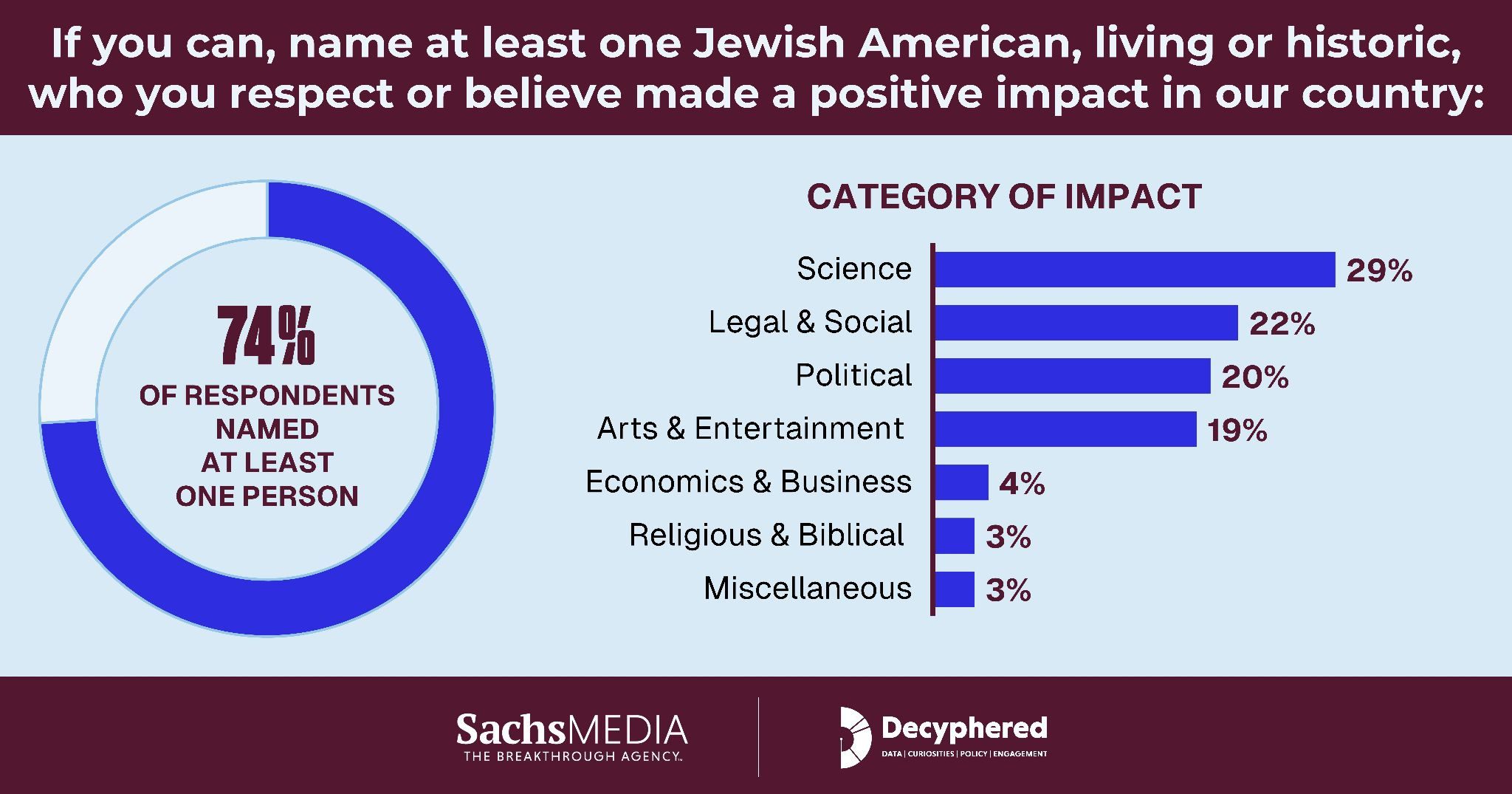
About 3 in 4 respondents (74%) provided at least one name. The remaining 26% either couldn’t think of one, left the question blank, or offered offensive responses not worthy of repeating.
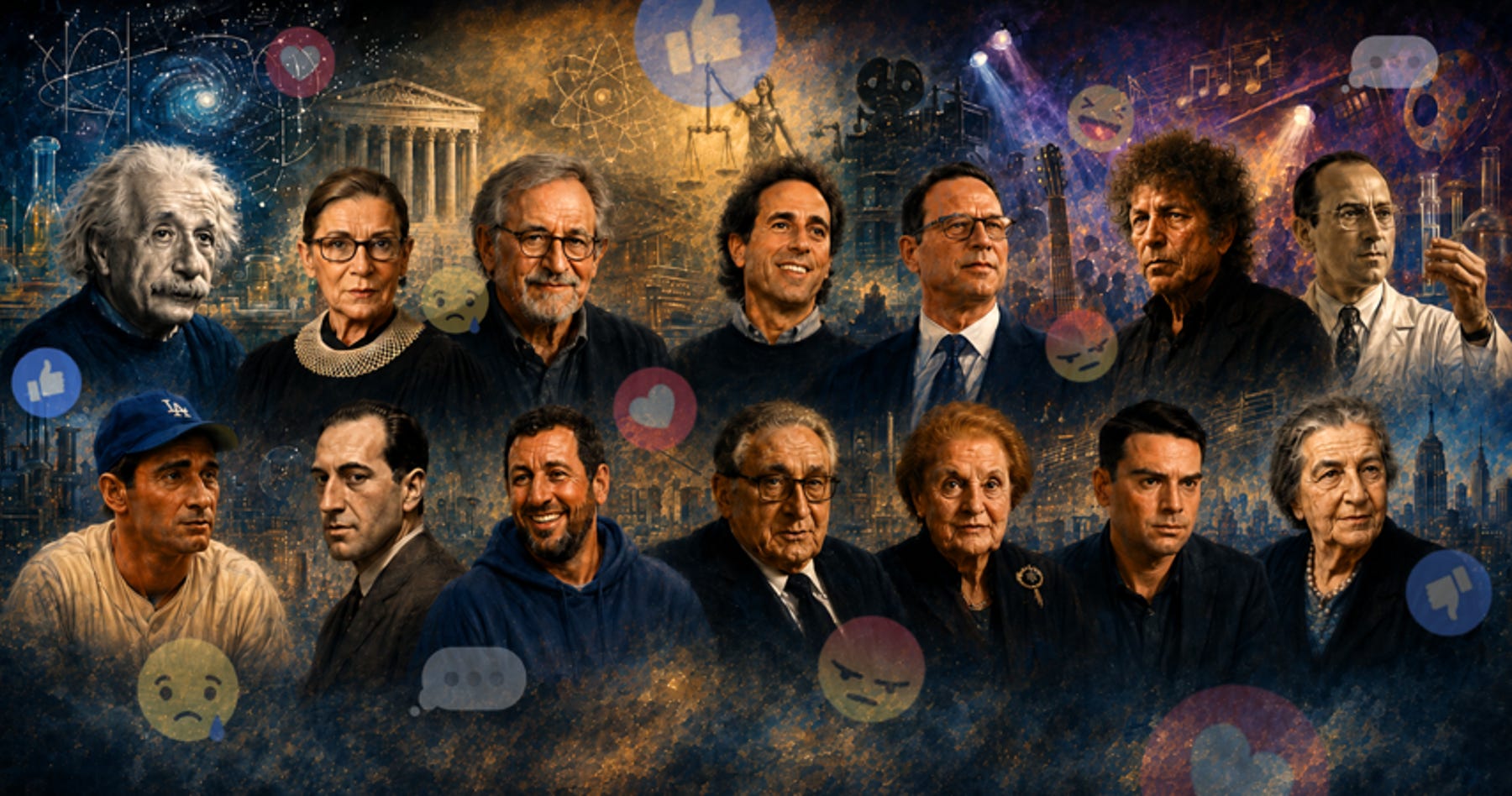
The names offered covered science, law, culture, entertainment, politics, religion, business, and public commentary. Some responses were factually off target – a few named people who are not American (such as former Israeli Prime Minister Menachem Begin or Sigmund Freud) – while others named people who are not Jewish, including Anthony Fauci, Mike Huckabee, and Jimmy Fallon.
But for the purpose of reporting on perception, if not reality, here’s what shook out:
Figures from science and medicine led the list, accounting for about 29% of all mentions. That category, however, was overwhelmingly driven by Albert Einstein, who alone accounted for about 24% of all mentions. Without Einstein, science and medicine would fall to about 5%, represented by figures such as Jonas Salk, Robert Oppenheimer, and Isaac Asimov.
The next major cluster was legal, social, advocacy, and public-commentary figures, at roughly 22% of mentions. Ruth Bader Ginsburg led this category, joined by Ben Shapiro, Alan Dershowitz, Mark Levin, Louis Brandeis, and Elie Wiesel. This suggests many voters associate Jewish American impact not simply with fame, but with civic, legal, intellectual, and moral influence.
Politics and government figures accounted for about 20% of mentions. That group included Henry Kissinger, Madeleine Albright, Josh Shapiro, Golda Meir, and a few Florida names, including Jared Moskowitz and Randy Fine. Just three named Haym Salomon, who significantly helped finance American Independence.
Entertainment, arts, sports, and literature were close behind, at about 19% of mentions. Names included Steven Spielberg, Mel Brooks, Jon Stewart, Jerry Seinfeld, Barbra Streisand, Adam Sandler, Irving Berlin, Bob Dylan, Sandy Koufax, Leonard Bernstein, and a member of my own family tree, George Gershwin.
The remaining mentions were more scattered. Business, finance, economics, and philanthropy accounted for about 4%, including economists Milton Friedman and Alan Greenspan. Religious or biblical figures (albeit non-American) accounted for about 3%, mostly Jesus and Moses. The remaining were miscellaneous, personal, or difficult to classify.
Taken together, the results show a complicated mix of recognition, uncertainty, admiration, and resistance. Most Florida voters say Jewish Americans have made a positive contribution to the country. Most can name at least one Jewish American they respect.
Those findings offer real cause for optimism. But they sit alongside other more troubling realities: opposition to formally recognizing Jewish American Heritage Month is meaningfully higher than opposition to recognizing Asian American and Pacific Islander Heritage Month, especially among some groups.
And the discomfort is not limited to heritage-month recognition. Multiple conspiracy theories about Jewish Americans remain very much alive in Florida. About 1 in 4 voters say it is at least possible that Jewish-owned food companies intentionally make food unhealthy to weaken non-Jews. Another 1 in 4 believe it is at least possible that global banks are secretly controlled by Jewish elites. Around 1 in 3 believe Jews control too much of the media. And in roughly the same range, 1 in 4 say Hamas’ October 7 attack on Israel was at least somewhat justified.
So, yes, there’s admiration. But significant portions of people, whose responses represent millions, are also willing to admit to pollsters a mix of suspicion, hostility, and conspiratorial thinking that shouldn’t be minimized.
From recognition to shared observance?
This Friday night marks what President Trump has called for as a “National Shabbat” from sundown on May 15 to sundown on May 16.
The proclamation says the observance recognizes the Jewish tradition of setting aside time for rest, reflection, and gratitude, and calls on all Americans to celebrate faith and freedom, especially on Shabbat.
Asked if they’d consider participating in this observation, fewer than 1 in 3 (31%) say they definitely would not (including half of Democrats, 1 in 4 nonpartisans, and 1 in 8 Republicans).
I take this as a sign of possibility: Even in a hyperpolarized environment, a majority of Floridians remain open to honoring a Jewish tradition framed not as a political statement, but as a shared civic invitation to rest, reflect, and give thanks.
And that’s something we can all use more of.
Your research on this topic is as fascinating as it is troubling, especially with regard to the Democrats who have turned a blind eye while antisemitism has become normalized in their ranks.
The age comparison is worth calling out as well. Younger people in both parties seem unaware of the role Jewish Americans played in preserving individual liberties, promoting civil rights, and (ironically) protecting free speech. Without a broad historical context, they fall for the same debunked conspiracies that fuel the KKK and other hate groups.
Thanks for another interesting read!
I am American and Jewish, MAGA Zionist conservative. I do not support "heritage month" or "history month" for any group, for women or for any ethnicity. They are divisive. We should all be unhyphenated Americans, with one American culture.