

It’s Evident: Americans would still co-sign these Truths
New survey finds 3 in 4 would sign their name to the Declaration today, for reasons spanning patriotism to renewal - even when the details are blurry

Somewhere in America this week, a county clerk is stamping a fireworks permit, a hardware store is restacking red-white-and-blue bunting, and some dedicated dads are repurposing trailers into parade floats.The occasion is the nation’s 250th birthday. And whatever Americans recall or misremember about the date itself, it turns out they agree, almost without exception, on what’s worth celebrating.
Conviction in the principles
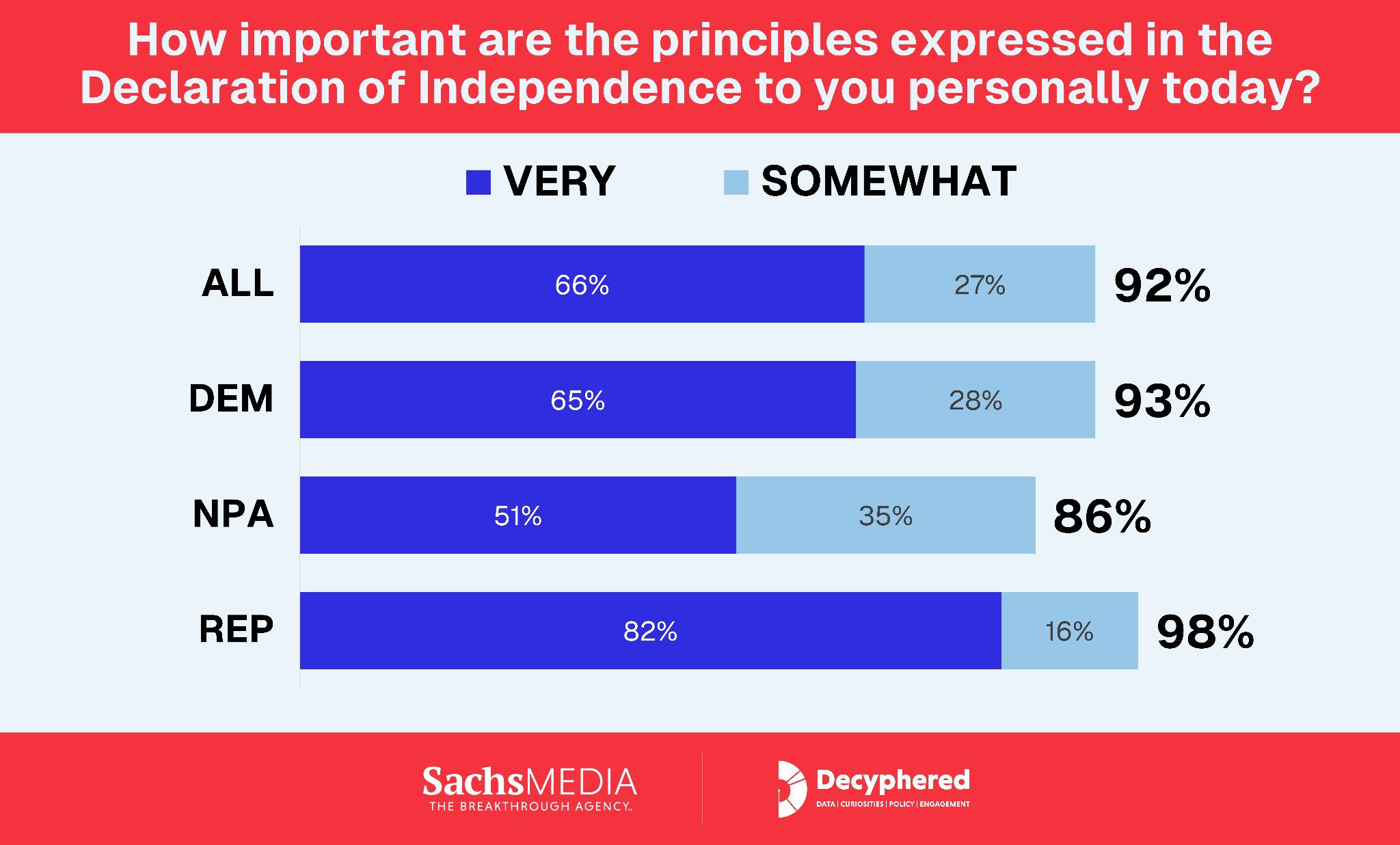
In a survey of 1,500 American adults fielded by our team at Sachs Media June 12-14, we read respondents the core ideas of the Declaration of Independence and asked how important these principles feel to them personally. The most heartening finding is that we remain largely united on the things that define us as a nation.
More than 9 in 10 (92%) called the principles important, with 2 in 3 saying very important. That nearly unanimous number was a unified sentiment across the fault lines that usually divide us today. Democrats came in at 93%, independents at 86%, Republicans at 98%. City, suburb, and small town landed within 2 points of one another. Men and women, young and old – all in relative agreement.
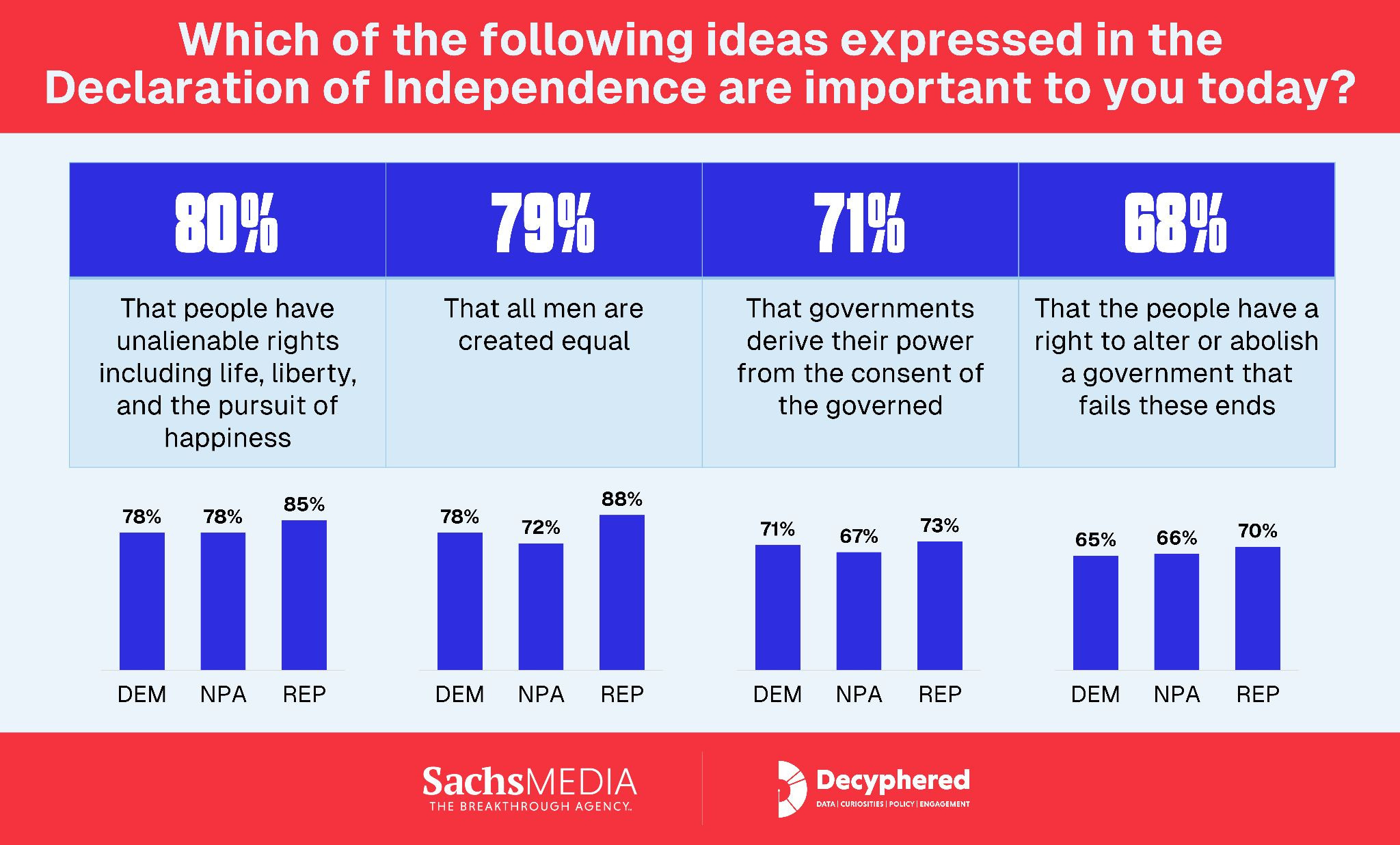
Asked which specific ideas mattered, 4 in 5 pointed to the unalienable rights of life, liberty, and the pursuit of happiness. Nearly as many embraced the proposition that all people are created equal. Consent of the governed and the right to alter a failing government followed close behind. Republicans and Democrats look remarkably alike on each of these, with only somewhat greater apathy among nonpartisans. Considering that it took root 250 years ago, the Declaration clearly still articulates values that Americans widely value and still hold dear.
Americans enthusiastic to co-sign the Declaration today, for varying reasons
As part of the 250th anniversary celebration, imagine that Americans were invited to add their own name, a personal signature, to the Declaration of Independence as a symbolic digital show of shared commitment.
That’s precisely what my mentor and friend Ron Sachs is bringing to life with a nationwide initiative. It’s called Sign ON 250 – under the leadership of the National League of Cities in partnership with America’s Newspapers, the Bob Graham Center for Public Service, and the James Madison Institute. It’s sponsored by Walmart, with other sponsors expected to join soon.
Sign ON 250 will invite Americans of all ages – at school, home, workplaces, and military bases, on tablets and cellphones, here and globally – to click on a simple link and add their own “John Hancock” to the document that lays out our nation’s founding principles. Millions are expected to “Sign ON” during the year-long campaign running through July 4, 2027. If you want to embrace and rededicate yourself to those guiding principles, you can click here: signon250.org.
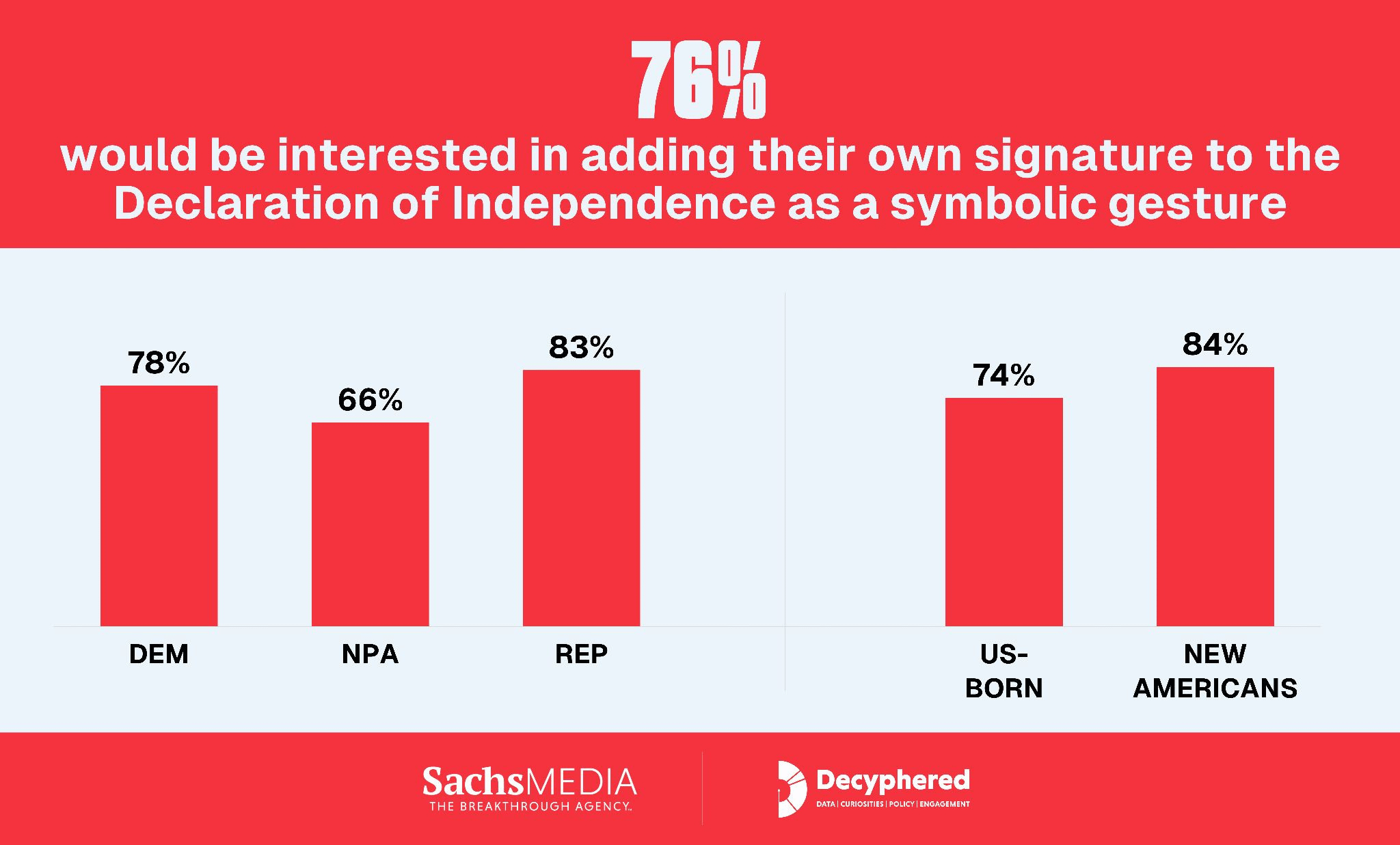
Our survey shows that Americans’ appetite for this invitation is widespread: More than 3 in 4 (76%) said they’d gladly add their name to the Declaration as a stamp of approval for the values it embodies. Another 7 in 10 said they would encourage friends, family, and neighbors to add their names, too.
The most eager would-be signatories are the newest Americans. Among respondents born outside the United States, more than 4 in 5 (84%) wanted to sign, versus 74% of those born here; 80% of foreign-born respondents would urge others to follow, compared with 68% of native-born.
Their reasons also differed. Where native-born Americans leaned on patriotism, unity, and personal legacy, foreign-born respondents were markedly more likely to frame signing as a civic duty – doing their part as an engaged citizen (named by 35% of this group, compared with 25% of the native-born). The people who made a choice to be part of this country tend to treat its founding promise as an obligation they’re honored to shoulder.
Zoom out, and the fuller picture is striking for its breadth
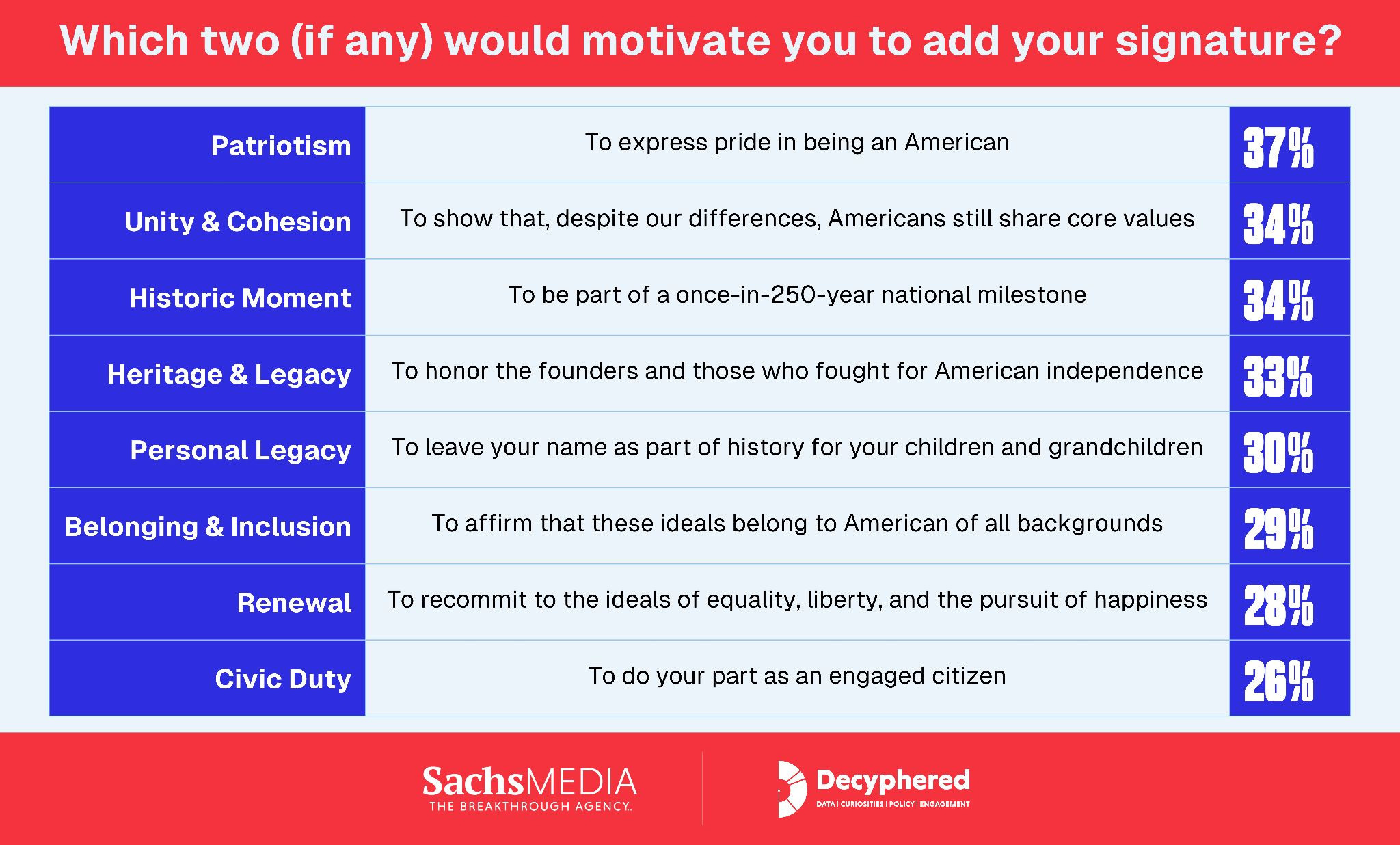
We offered eight reasons someone might sign and asked respondents to say which two would be most motivating. The first thing that stands out is how evenly they landed: Each option drew between roughly a quarter and a third of respondents, with no single motive running away with it. People want to sign – they simply arrive at the pen from different directions.
Patriotism led the list (37%), followed closely by unity and cohesion, the sense that despite our differences Americans still share core values (34%), and the pull of a historic moment – a once-in-250-year milestone (34%). Heritage, personal legacy, belonging, renewal, and civic duty filled out the rest, each within a few points of the previous one.
A unifying gesture can hold many private meanings at once, which is more or less the founding premise of a self-governing people. That explains why some philosophical differences show up, even amid all the unity.
Republicans gravitated toward patriotism, heritage, and the chance to leave a personal legacy; Democrats leaned toward renewal and belonging – the sense that these ideals are worth recommitting to, and that they belong to Americans of every background.
Men were somewhat more moved than women by the historic-moment framing (39% to 29%), while unity resonated most with Republicans (43%) and the native-born; the more education someone had, the more reasons they tended to find, with graduate-degree holders citing unity, patriotism, and heritage each at about half. Same document, and same invitation to sign on oneself, but different doorways in.
Confusion in the details
Of course, for all that enthusiasm, there’s a teachable moment hiding in plain sight. Plenty of Americans would be hard-pressed to say precisely what they’re so eager to sign.
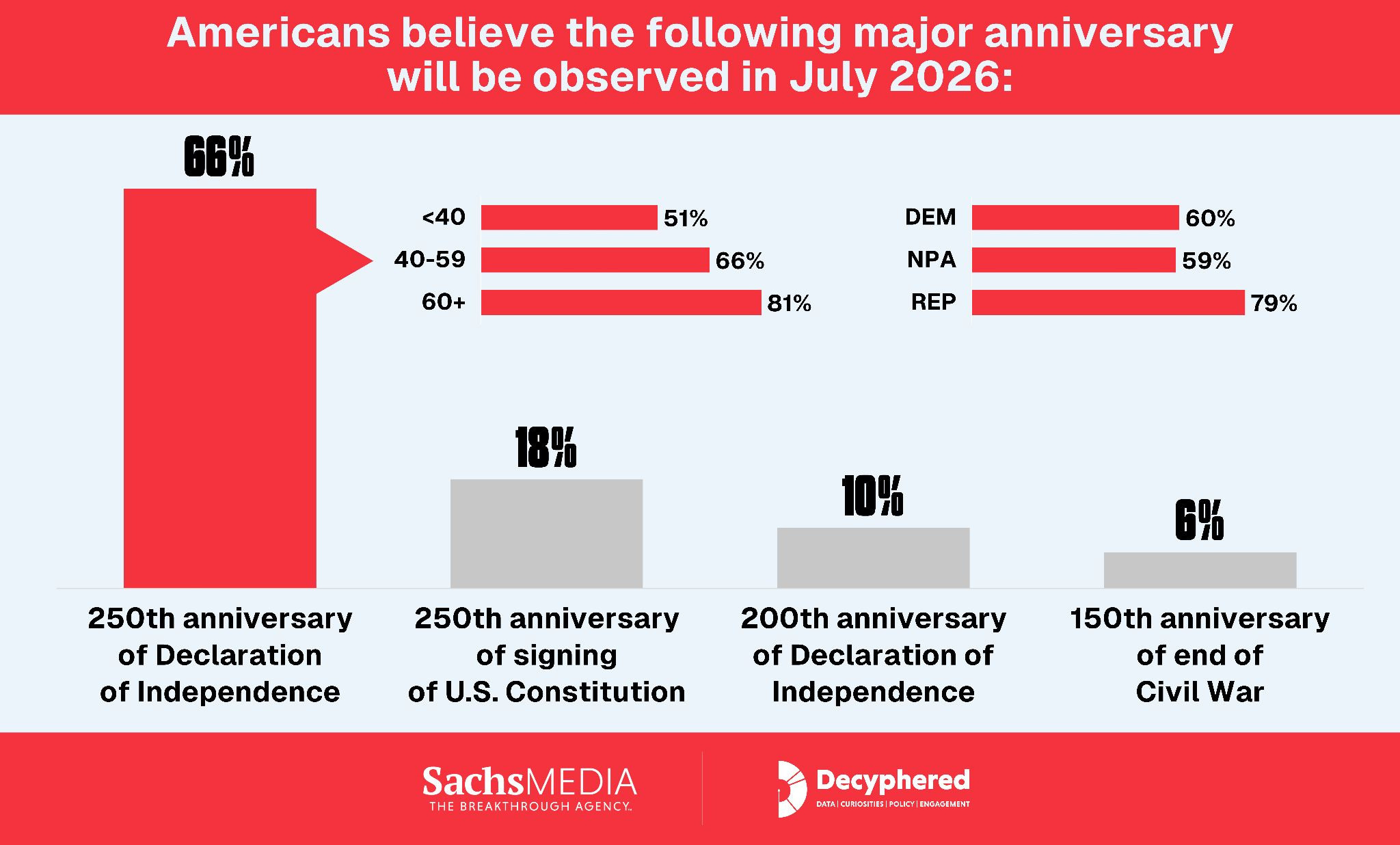
Return to the fireworks and the bunting. If you stopped the people buying the sparklers and other festive items and asked them what, exactly, is happening on July 4, a healthy share would pause. About 2 in 3 (66%) correctly identified the upcoming milestone as the 250th anniversary of the Declaration of Independence. The remaining one-third, however, spread their guesses among several incorrect answers: 18% thought the day commemorates the signing of the U.S. Constitution, roughly 1 in 10 split the difference and called it the 200th anniversary, and a stubborn few pegged it to the end of the Civil War.
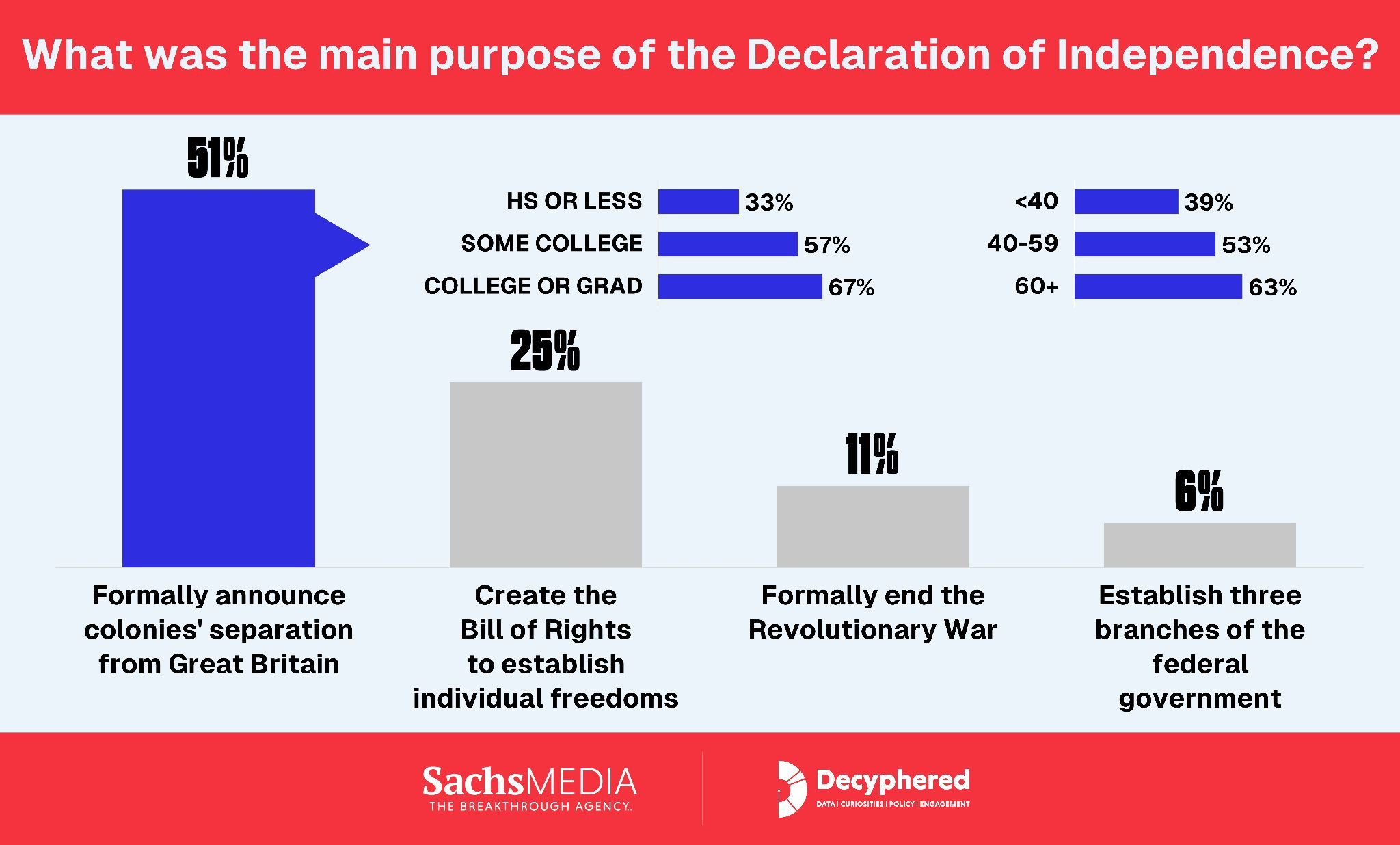
Knowledge about the meaning of the Declaration itself fares a little worse. Asked the main purpose of the foundational document, only half (51%) got it right – to announce the American colonies’ separation from Britain. About 1 in 4 believed it created the Bill of Rights, and the rest credited it with ending the Revolutionary War or setting up the three branches of government. So the document we’re preparing to honor with great fanfare and ceremony remains, for at least half of Americans, a bit of a blur.
The fog is thickest among the young. Americans 45 and older named the Declaration’s purpose correctly 58% of the time; among those under 45, the figure fell to 39%. Formal schooling moved the needle hard, too: Among those with a high school education or less, just 1 in 3 correctly identified the purpose – a number that doubled to 65% among those with at least some college or more.
So a country that struggles to name precisely what we’re celebrating agrees, almost without exception, on the values being commemorated. Confusion in the details, conviction in the principles.
56 signatures, with room for many millions more
The Declaration of Independence carries 56 signatures. Every one belonged to a white man of standing, because in 1776 the room was only open to such men. The signers declared that all are created equal, then established a country that took the better part of 200 years to begin to behave that way. This survey suggests that the rest of us have been waiting just outside that room, ready to come in.
Picture those 56 names joined by several million more – foreign-born and fourth-generation alike, city and small town, every political party or none – each adding a hand to a page first written without them.
That gesture would cement the document’s meaning, widen its authorship, and make good on its promise. And that’s certainly something worth celebrating this July 4, and always.