

Introducing Decyphered
What would you like to know? Let's ask some questions together ...

I spend much of my days conducting large-scale professional polling, teaching policy and American government, and running data analyses. In my role as partner and director of research at Sachs Media, I’m fortunate to have the flexibility to pursue investigations on topics of interest to our clients, my students, and myself.
Some of these interests were born over the 22 years and counting I’ve worked in and around Florida politics, but most of them are the same questions that cross many minds while reading the news, interacting with strangers or friends, and picking up on what often feels like curious signals from the world around us.
Beyond the usual suspects — voting behavior, tricky social issues, policy conundrums, and such—I add questions and experiments into surveys every chance I get, for no reward other than the satisfaction of curiosities or the hope that it might advance a cause I care about.
Many questions become regular features in our surveys, helping track trends over time. Others are more like momentary sparks — observations that get jotted down and tucked away for another day, another dataset, or fodder for a data visualization in Florida Politics evening digest, Last Call.
The results of these explorations are scattered across a range of digital platforms, academic journals, and my own notes, forming a patchwork of insights with no central home, no easy way for others to engage with the work, and no forum to inspire new ideas or collaborations. I want to build an interactive “home” where the various projects we’ve conducted can live and be shared.
This Substack will be that place.
Here are some of the things I’ve learned along the way, in no real order — followed by an inquiry to this community: What would you like to know? Let’s ask some questions together …
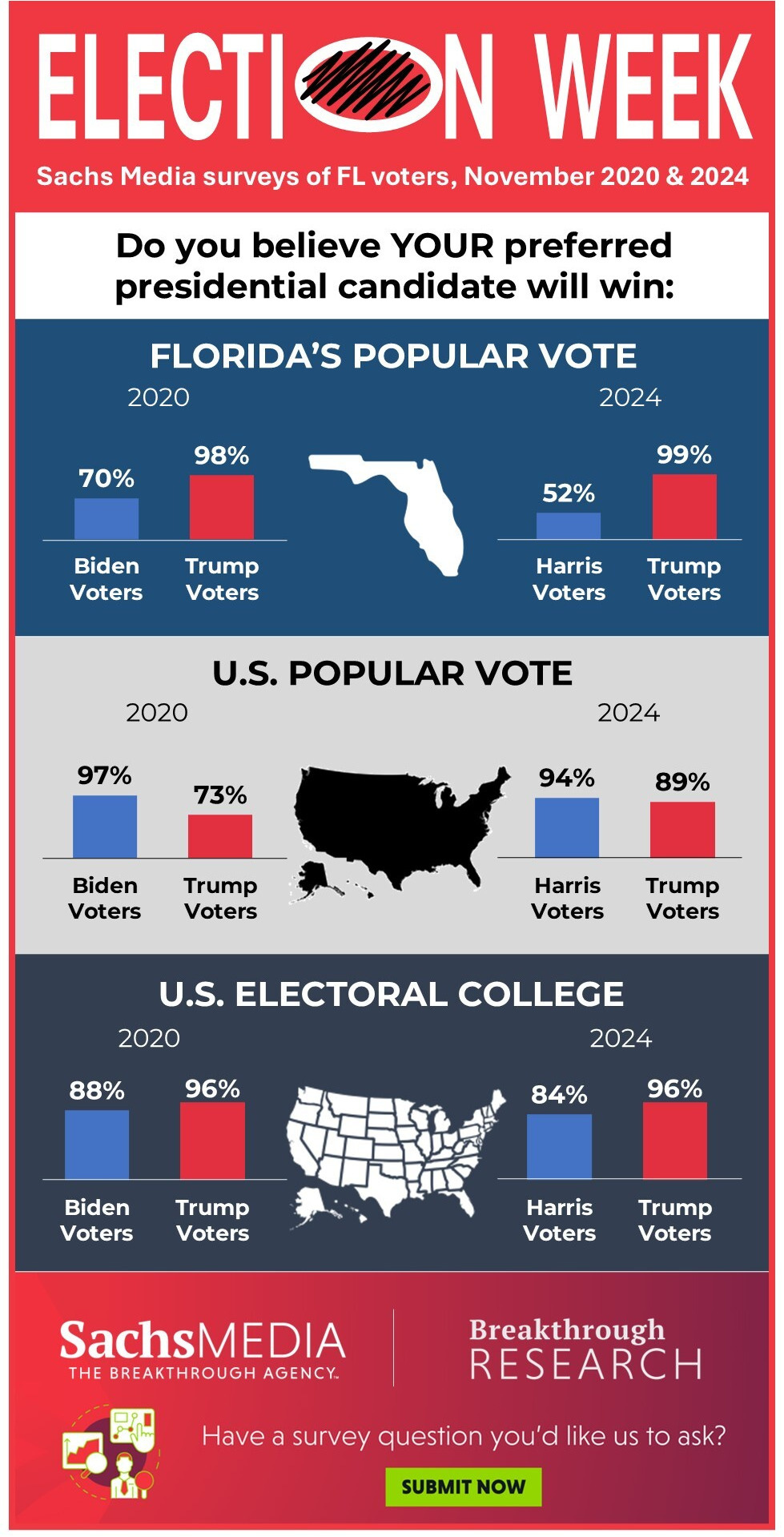
Confirmation bias, proven: Heading into the 2020 showdown between Donald Trump and Joe Biden, 96% of Trump voters and 88% of Biden voters believed their candidate would prevail. That level of confidence among members of both major parties was unseen in prior election cycles. This suggests unprecedented levels of confirmation bias — people reading and listening to only those sources whose predictions, commentary, and distortions they already approve of, which (for about half of the population in this case) amplifies blind spots and false hope.
TMI? Too soon?: Oversharing on social media may cause young people to become entrenched in their views too soon. More than half (52%) of Floridians acknowledge that if their political views had been shared widely on social media when they were young, they would have been less open to hearing opposing views in the years that followed, less likely to change their views over time, or more likely to still hold those same views today. This is equally true for Republicans, Democrats, and Independents, and equally the case for men and women.
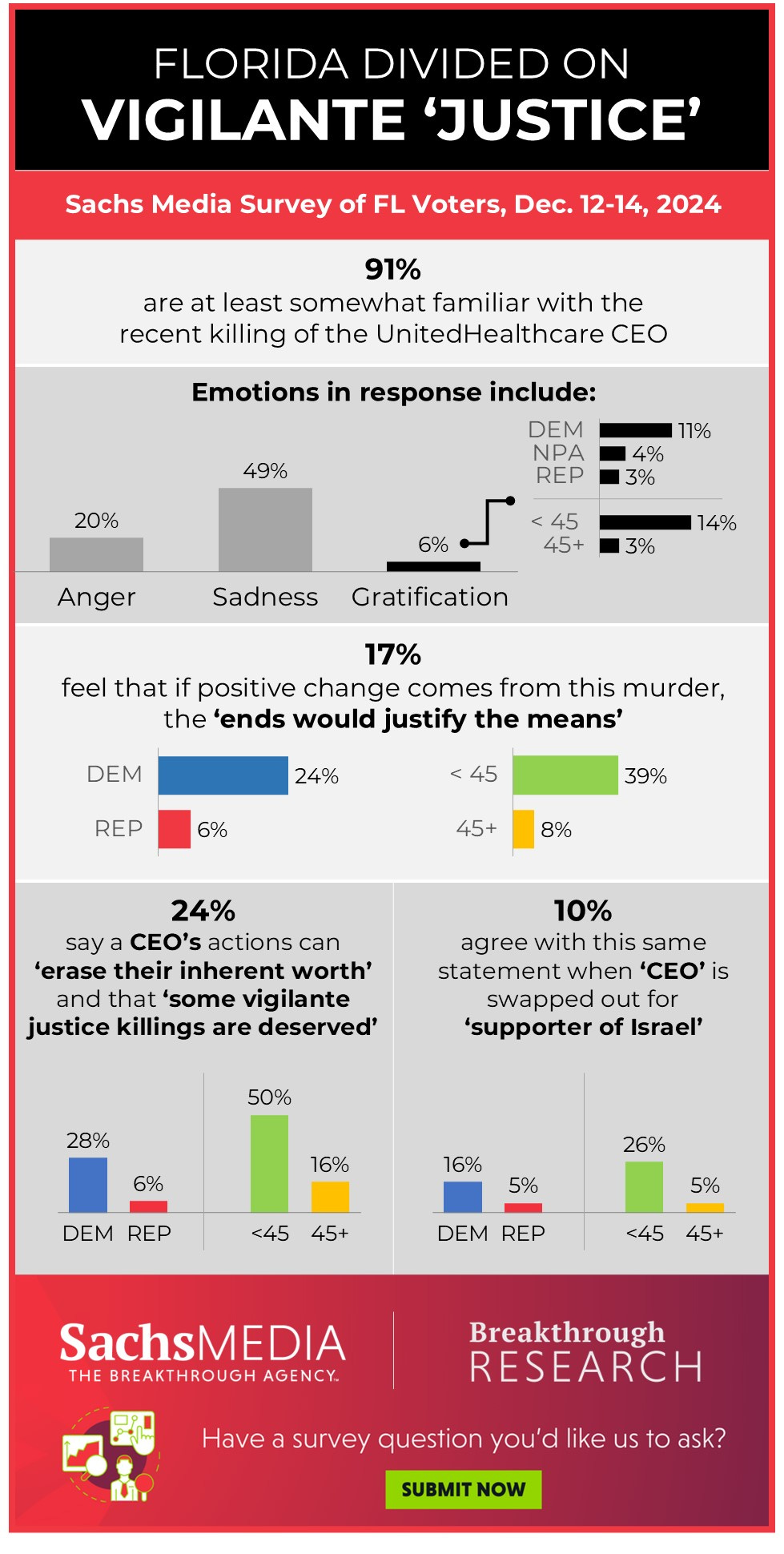
Murder is bad, part 1: Frighteningly, 4 in 10 Floridians under age 45, and 1 in 4 Democrats, believe that the ends would justify the means if the broad-daylight execution of the UnitedHealthcare CEO led to some “positive changes” in the health care industry. Shockingly, just 63% overall said that the killing would “definitely not” be justified, even if some “good” came of it. A significant portion of Floridians appear willing to excuse acts of violence if the motive aligns with their own beliefs or complaints. This apparent lack of sympathy may be personal, but such an overt celebration or rationalization of violence is extremely troubling. These findings were replicated in various other national surveys.
Murder is bad, part 2: After my friend Dan Markel was murdered at his Tallahassee home and authorities said members of his ex-wife’s family had hired hitmen to kill him, his ex-wife promptly cut off all contact between Dan’s parents and his two young sons. The boys’ mourning grandparents had no recourse, no legal standing in Florida to seek reunification — they couldn’t even petition the court for visitation. So I initiated efforts to change Florida law — and with a great team of lobbyists, advocates, and Dan’s family, we prevailed. The Florida Legislature passed and the governor signed a bill that had wide public support. I’ll be forever grateful for the experience of working on The Markel Act.
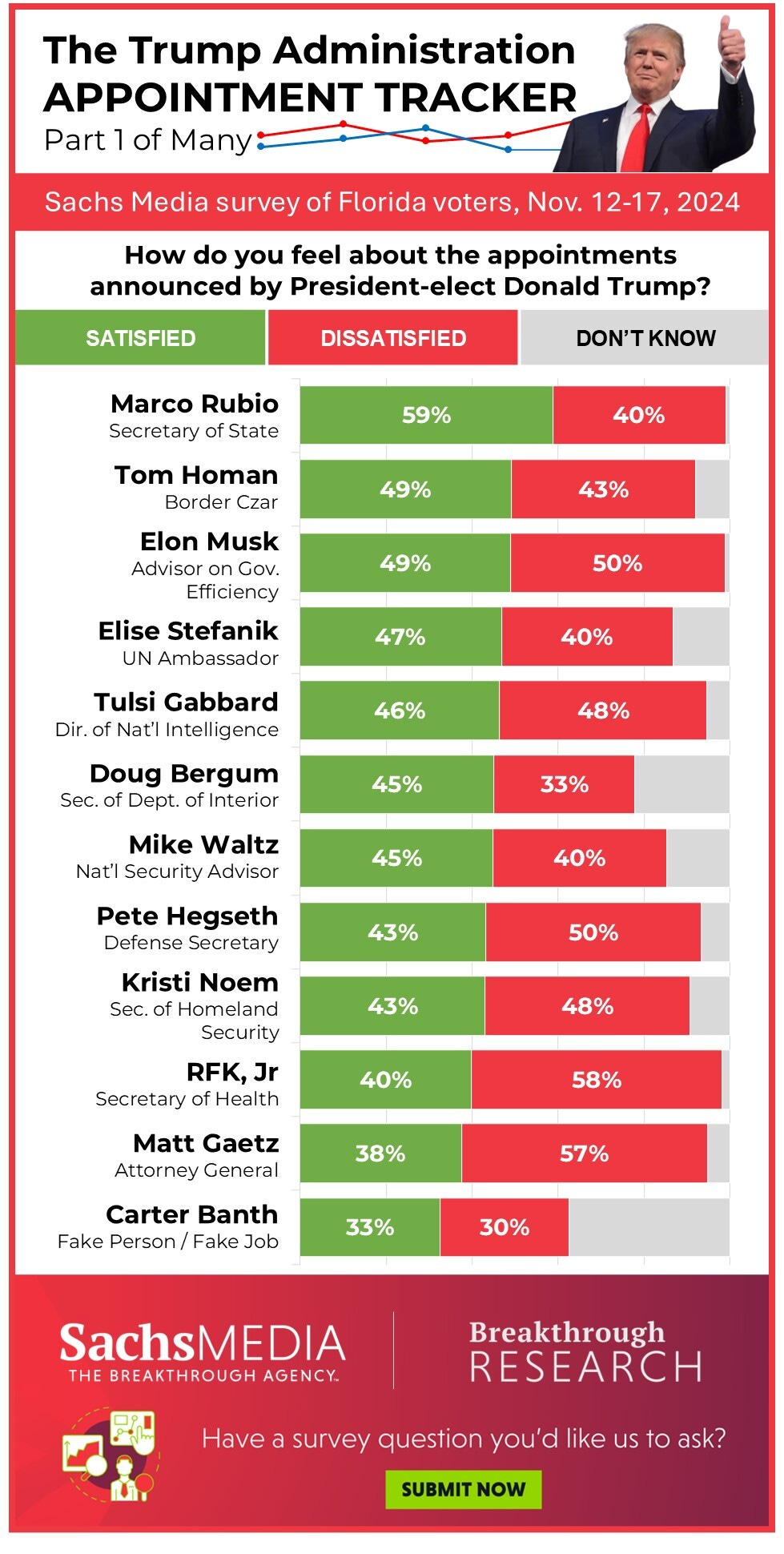
Fake news, real feelings: Shortly after President-elect Trump named a number of high-level nominees for top positions, I conducted a survey about public feelings toward the appointments – and I included a person who doesn’t exist for a post that’s equally fictitious. Still, 55% of Republicans approved of the person while 56% of Democrats disapproved. Overall, not even 4 in 10 could bring themselves to admit they didn’t even know who the person is. Liking (or disliking) the person making the appointment appears to be the only thing most people need to know before casting judgment on the appointee.
How are people so certain?: When Trump appointed Brett Kavanaugh to the U.S. Supreme Court, we polled Florida voters on allegations he had committed sexual assault. Stunningly, just 12% said they weren’t sure what happened, with the rest — highly divided along party lines — either sure he did (Democrats) or didn’t (Republicans) do so. That was a lot of certainty, considering that the FBI had yet to report on its actual investigation into the matter — and considering that the evidence available to the public to date has mostly been one person’s word against another’s. It goes to show how so many issues today are viewed primarily or exclusively through a partisan lens.
Don’t put your politics on your resume if you really need that job: 1 in 5 hirers acknowledge that they would decline to interview a qualified junior-level IT specialist if that person’s resume suggested a political orientation different than their own. This finding was found through an experimental design where respondents saw one of two resumes, differing only in whether the applicant listed a prior role as VP of either the “Young Republicans” or “Young Democrats.” The bias was about equal between parties, for what it’s worth.
Antisemitism isn’t what it used to be — it’s all that and a whole lot more: Antisemitism rose dramatically following the October 7, 2023, Hamas attack on Israel, with the increase dominated by views among more liberal and younger voters: 40% of those under age 45 and 35% of Democrats believe Hamas was at least somewhat justified in its attack. There’s been four-fold increase since 2019 and a 70% increase since 2022 in the portion overall who believe Jews are responsible for what happened to them in the Holocaust. Some of our other experiments also revealed stark double standards regarding the fairness of a country retaliating for attacks on its people (it’s okay, unless its Israel) or for state lawmakers to make diplomatic trips to another country (again, cool, unless …).
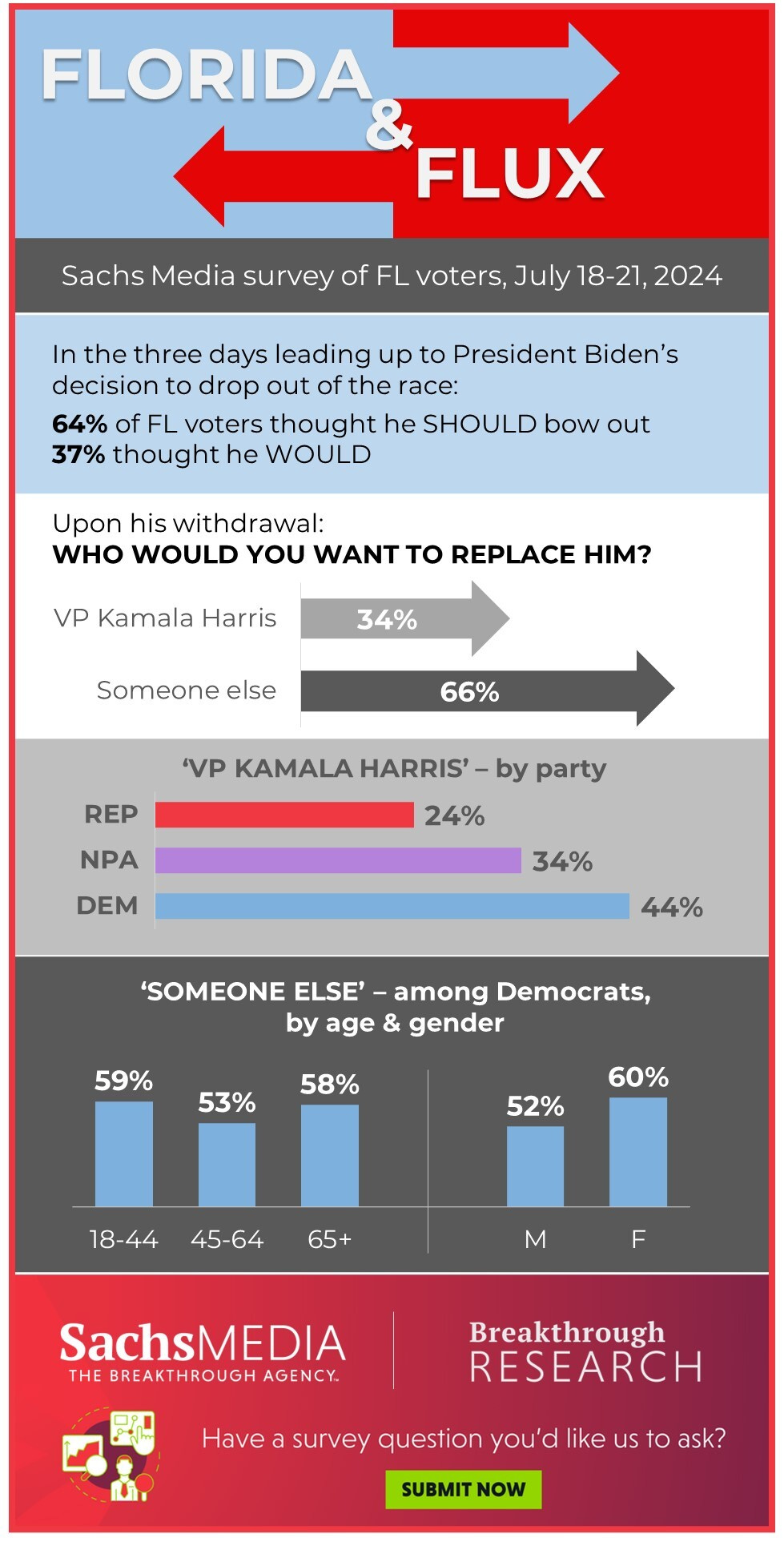
Smoke and mirrors: In the three days leading up to President Biden’s decision to drop out of the race, 64% of Florida voters thought he should do so, but just 37% thought he would. Upon his withdrawal, we asked Floridians who should replace him, and just 34% named Vice President Kamala Harris — including just 44% of Democrats. “Someone else” won handily against her — at least prior to the party establishment rallying quickly behind her, support that didn’t translate into sufficient enthusiasm (and votes) in November.
Those weren’t easy years for anyone, and moms of young kids doubled down: In two-parent, double-income households, it was overwhelmingly mothers who took on homeschooling responsibilities while also working their own jobs in the early months of COVID-19 shutdowns. Plenty of dads also stepped in, but expressed less concern than moms over how it would impact their livelihoods.
Memes make cray-cray seem less crazy?: Memefication seems to make crazy ideas seem less crazy. Seeing conspiracy theories in meme form more than doubles their believability compared to the exact same content shared in text form only. In comparison, generally non-conspiratorial content doesn’t enjoy a credibility boost from getting meme’d. Perhaps this is because memes are assumed to be viral by the time the reach any given person, suggesting implicitly that they’ve made their way through many filters of highly discerning critical thinkers to get there?
I’m less upset about it now, but if anyone has a direct line to the internet’s manager…: Even in the early days of the meme, people named “Karen” were no more likely than the general public to have demanded to speak to a manager or confronted a stranger in the prior 12 months. Trust me: I surveyed 3,000 Karens and equal numbers of everyone else (the lucky ones) whose names weren’t ruined by a meme.
Moot point, perhaps, but smartphones make people seem farther away: With the help of my sister Lauren Halperin, who runs an acting studio, we staged an experiment to see how the presence of a smartphone versus a newspaper changed people’s perception of the social landscape. Survey respondents saw either an image of a young couple sitting on a couch each reading a newspaper, or saw an otherwise identical image of the same couple sitting while each reading from a smartphone. The newspaper couple was rated as significantly stronger and closer to one another than the smartphone couple. In other words, people doing crosswords or reading the news on their phones seem more distant from one another than do the same two people doing the same things sans phones. I conducted this experiment what may as well have been 150 years ago, in 2018. Today, I’m not sure there’d be any point bothering to repeat the exercise — do couples even sit around with print newspapers anymore?
Sock-shoe sock-shoe, who?: 1 in 6 people subvert the more common sock-shoe-sock-shoe order of getting ready, instead dressing one foot fully before the other each day — a habit shared by 20% of Republicans but only 12% of Democrats. I like sock-sock-shoe-shoe … how else can you figure out if you like the pairing or keep the opposing foot debris-free in between the sock and shoe phase of the routine?
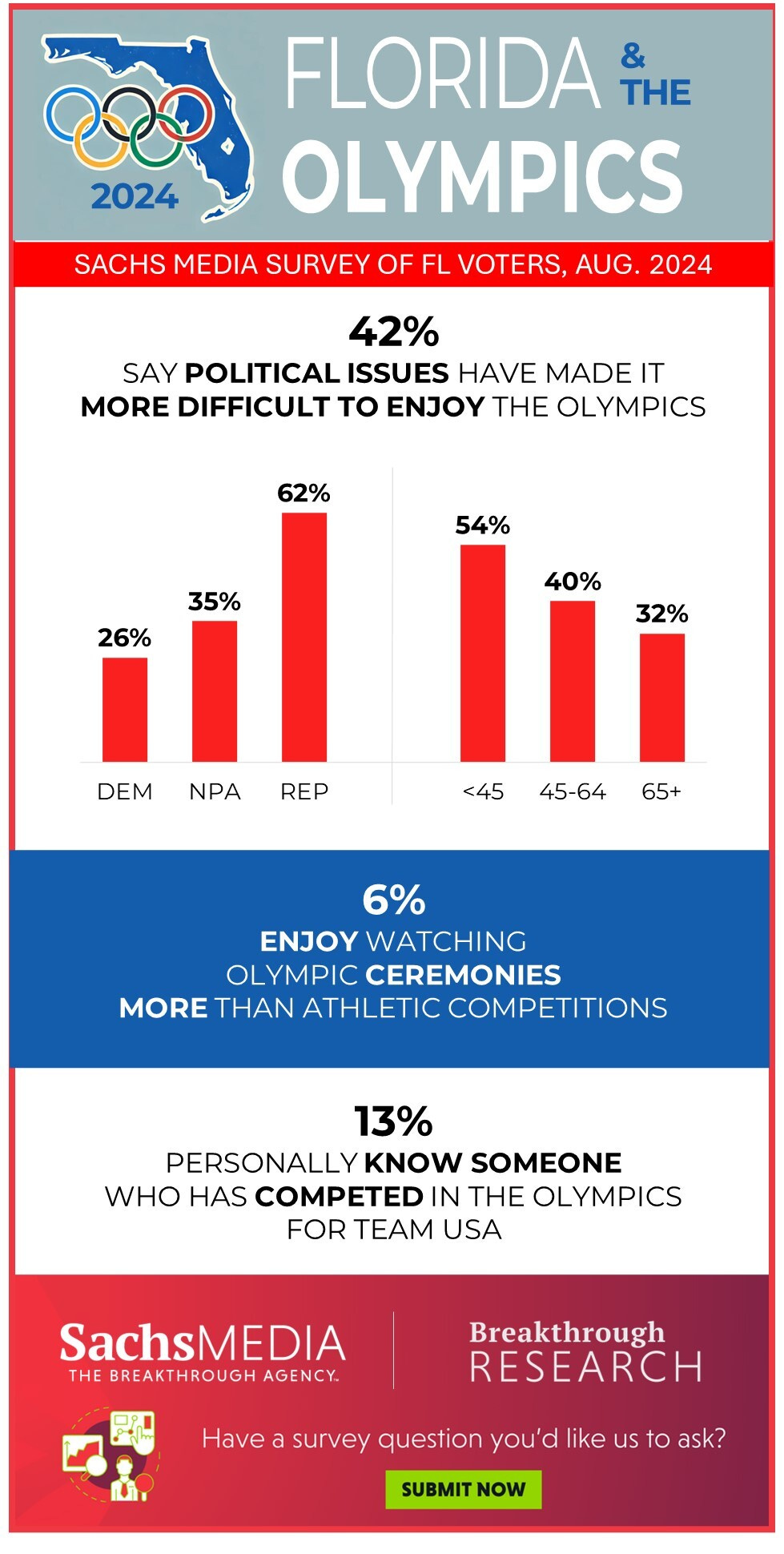
And the pewter medal goes to politics: 4 in 10 Florida voters said political issues compromised their ability to enjoy the Olympics at all, including 58% of Republicans, 35% of nonpartisans, and 24% of Democrats. But even so, 87% still said they watched at least one event.
Who knows if this aged well or not: In April 2023, some 6 in 10 Florida voters thought DA Alvin Bragg’s indictment of Trump was politically motivated, while even larger portions believed this prosecution would ultimately benefit, not hurt, the former president. These feelings were concurrent with a view held by nearly 3 in 4 (74%) that Trump did in fact provide a hush payment to Stormy Daniels.
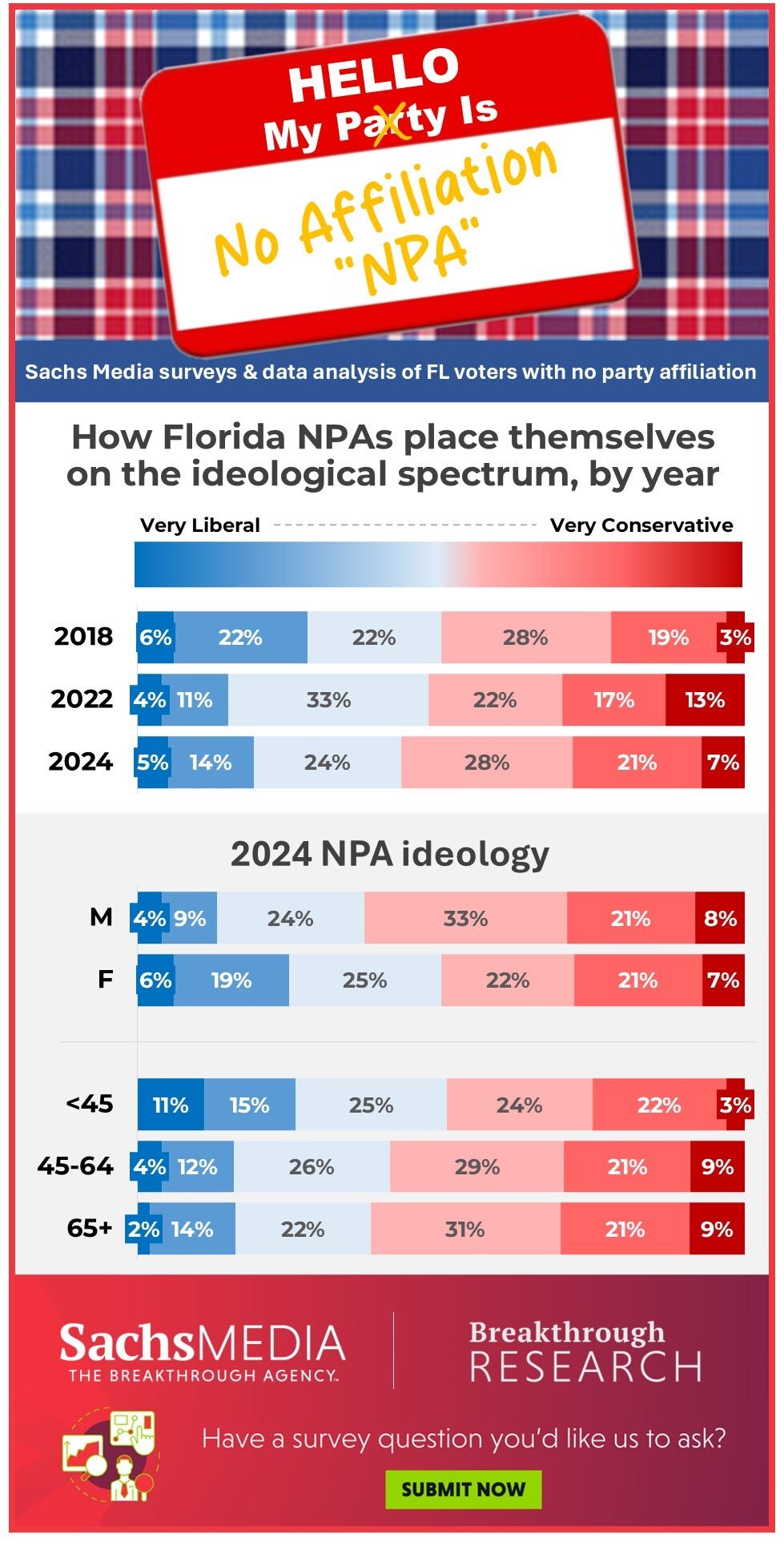
Non-partisan doesn’t mean no opinion, but it does mean sitting out important primaries: As of late 2024, Florida’s voter rolls included over 3.5 million voters unaffiliated with any political party, representing 26% of the total electorate —marking a 10-fold increase in the share of NPAs since the early 1980s. About half of new, young voters are registering without affiliation. While three-quarters of NPA voters (73%) believe both major political parties are corrupt and 70% lament that their former party has strayed too far from its values, these unaffiliated voters have erased their own ability to help shape the future of either party in Florida’s closed primaries. Clearly, some NPAs feel that it’s more important that their voter ID card reflects their views than it is to have their views reflected in the candidates each party advances — but that’s a self-perpetuating tradeoff with real consequences in the aggregate.
Florida’s Hispanic population is extraordinarily diverse: It’s a population often misunderstood to be monolithic, while in reality it represents a wide array of nationalities, cultures, and experiences. A close examination of this unique demographic tells a story not just of growth, but of profound variety and influence. Florida’s Hispanic voters are almost equal parts Republican (35%), Democrat (34%), and non-partisan (31%). Our polling finds that Florida’s Hispanic voters are more moderate — less extreme, whether to the right or the left — than their fellow party members.
“I” vs “We” in candidate speak: The 2016 presidential primary debates gave us a chance to measure how often candidates said certain words, including their use of “I” versus “we” in talking about their acts or plans. Among the Republicans in the race at that time, Trump had the lowest proportional use of “we” — but perhaps more egregious was Bernie Sanders’ self-referential use of the third person.
I’ll take “not surprising” for $200, Alex: It turns out that when more lobbyists lobby for a bill, its chance of passing goes up. And when Democrats are prompted to think about the #MeToo movement before they’re told of a Bill Clinton endorsement, the influence of that endorsement goes down.
Term limits are here to stay, but not because they did what they promised: Legislative term limits were enacted in Florida under the premise that they’d make elections more competitive and diverse — but our research found this was hardly the case. And, while political parties and lobbyists have various motivations for opposing term limits, most say it’s because of a reduction in institutional knowledge and expertise.
The opportunity cost of cannabis gatekeepers: Ten years ago I visited California and tested out that state’s “medical” marijuana system, and wrote a cautionary account of why Florida shouldn’t go down the same path. But we did. Today, Floridians can find dozens of open 5-minute (to be generous) appointments in their city every day of the week to score cannabis “recommendations” from a fully-accredited physician — a medical doctor who could (would?) otherwise be opening up appointments for patients to solve real medical problems. Sure, weed can help some conditions. But these doctors aren’t protecting the public from the masses getting high, and so the system shouldn’t incentivize them to waste the value of their medical expertise under the ruse of doing so.
“Come on, Walter, this is not a First Amendment thing, man” — The Dude.: About 1 in 3 Floridians (36%) can name all five of the First Amendments rights: freedom of speech, freedom of the press, freedom of religion, the right to peaceable assembly, and the right to petition the government. At the same time, most (80%) are concerned about government restrictions on what people can express or be free to practice, and about the same portion are concerned about significant bias in the media itself. Many others misunderstand what the freedom of speech includes, and what it doesn’t. There’s a lot more to be looked at here…
All terms of a sentence? In 2018, Floridians voted to amend the state constitution to restore voting rights for nonviolent felons once all terms of their sentence were completed. The Florida Legislature implemented this measure in 2019, requiring aspiring voters to pay all financial obligations (fees, fines, and restitution) that were part of their sentence before voting rights could be restored. While courts debated if it was constitutional to require the repayment of fees, we surveyed Florida voters to find out how they felt: What does “all terms” of a sentence include? A majority interpret it to include fines, especially when framed in terms of restitution to victims.
Long after the cockroaches are the last remaining life form on Earth, some will still debate whether hot dogs are sandwiches: If we’re out of hot dog buns, my husband Brett won’t eat a hot dog, while I’d be happy to wrap mine in regular old white bread. To me, my husband’s strong feelings confirm that hot dogs aren’t simply open-faced sandwiches. And indeed, 6 in 10 reject that premise. Interestingly, it’s young people who are especially certain of the distinction.
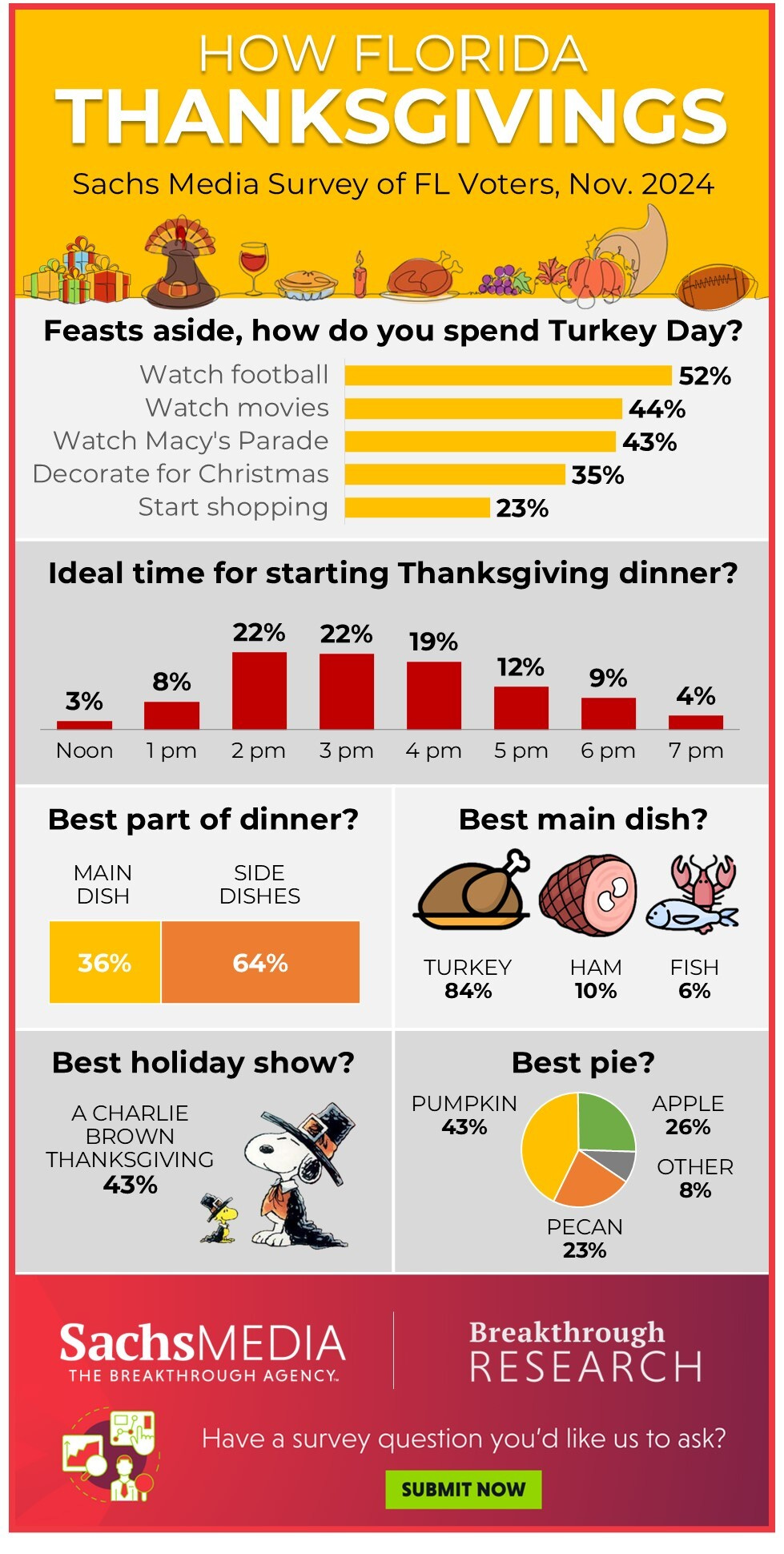
Side dishes for the win: Almost 2 in 3 Floridians (64%) say the best part of Thanksgiving dinner is the side dishes, not the main course — which, in its own right, is predictably dominated by turkey (84%) followed distantly by ham (10%) or fish (6%). And pumpkin remains the favored Thanksgiving pie by a plurality (43%), followed by apple (26%), pecan (23%), or “other” (8%).
This is just sad, and avoidable: Following the 2024 elections, 1 in 10 Floridians said they planned to avoid family holiday gatherings due to political differences. This includes 1 in 5 Democrats (21%) and 8% of non-partisans, but just 1% of Republicans. What a shame — especially considering that most families seem willing to avoid touchy topics: The portion of people who talk about politics during family gatherings has declined from 51% in November 2019 to 35% in 2024.
Personality and identity in politics: My graduate mentor, Jeff Mondak, had a lot of ideas about a lot of cool things, and I was lucky to be around when he did. We published a paper together on how all facets of the Big Five personality traits framework matter for citizen politics, with personality effects operating on virtually all aspects of political behavior. Spoiler alert: Extraversion correlates highly with political participation; conscientiousness with conservatism; and agreeableness with Democratic partisanship.
Donating up with the Joneses? People donate more to political campaigns when they’re given information on average donations made by other members of their political party, and also of their racial and ethnic groups. This was the main finding of a paper I published with FSU faculty members Kai Ou and Hans Hassell, using survey methods and a randomized field design.
Can you love someone who thinks differently? In September 2020, 86% of married Florida voters said they and their spouse would be voting for the same presidential candidate. In September 2024, this dropped to 74%. While we can’t tell from this data if those split-vote couples stay together, at least for the time being it’s a hopeful statistic. Indeed, in February 2024, more Floridians said it was most important to share religion with a partner (43%) rather than preferences in food (28%), politics (18%), or entertainment (11%). In the same survey, 1 in 7 said they’d ended a relationship due to conflicts over political beliefs, including 20% of Democrats and 13% of Republicans. And previous of our surveys found that more than 1 in 10 feel they simply couldn’t love someone who has different political views. This is definitely one question we’ll repeat more over time.
And then there’s the stuff that makes me dream of a stint on Family Feud: More people are scared of the government (65%) than they are of snakes (26%), spiders (7%), or ghosts (2%); 4 in 10 would rather enjoy a staycation than travel over the summer; fully half would not consider going to a political rally, and wouldn’t attend even if it was literally held in their backyard; 25% can’t pass a test on basic generator safety following storms; 6 in 10 supported a provision to ban TikTok if its parent company failed to sell it within 9 months; 66% believe in UFOs (at least in October 2023 — should probably ask that again now since 2024 was a big year for unidentified flying objects!), 51% believe in ghosts, and 16% are superstitious about breaking mirrors; about half believe self-driving cars are safer than human-driven cars; and while about the same portion believe that humans are currently “smarter” than AI, 1 in 4 believe there will be a point where humans will lose control of AI. When it comes to college football, the Gators have only slightly more fans than the Seminoles, but nearly everyone feels the sport unifies more than it divides people. Finally, for now, most Floridians understand what it means when a Gen-Z person says “slay” — but few are in on the tea about rizz.