

Free speech in theory, fragile in practice
How power and partisanship warp the standards we claim to share

In Tolkien’s world, every would-be hero swears they can resist the lure of the Ring. In Washington, every new administration enters the White House promising it can resist the temptation to control or silence speech. Both stories remind us that the greatest danger isn’t just the urge to control, it’s believing – and convincing others – that you won’t.
If you ask Americans what they think of government efforts to stifle content, you’ll hear general unanimity in the abstract. And while there are partisan divides in perceptions, a growing majority of people think both sides have poorly handled power when it comes to free speech.
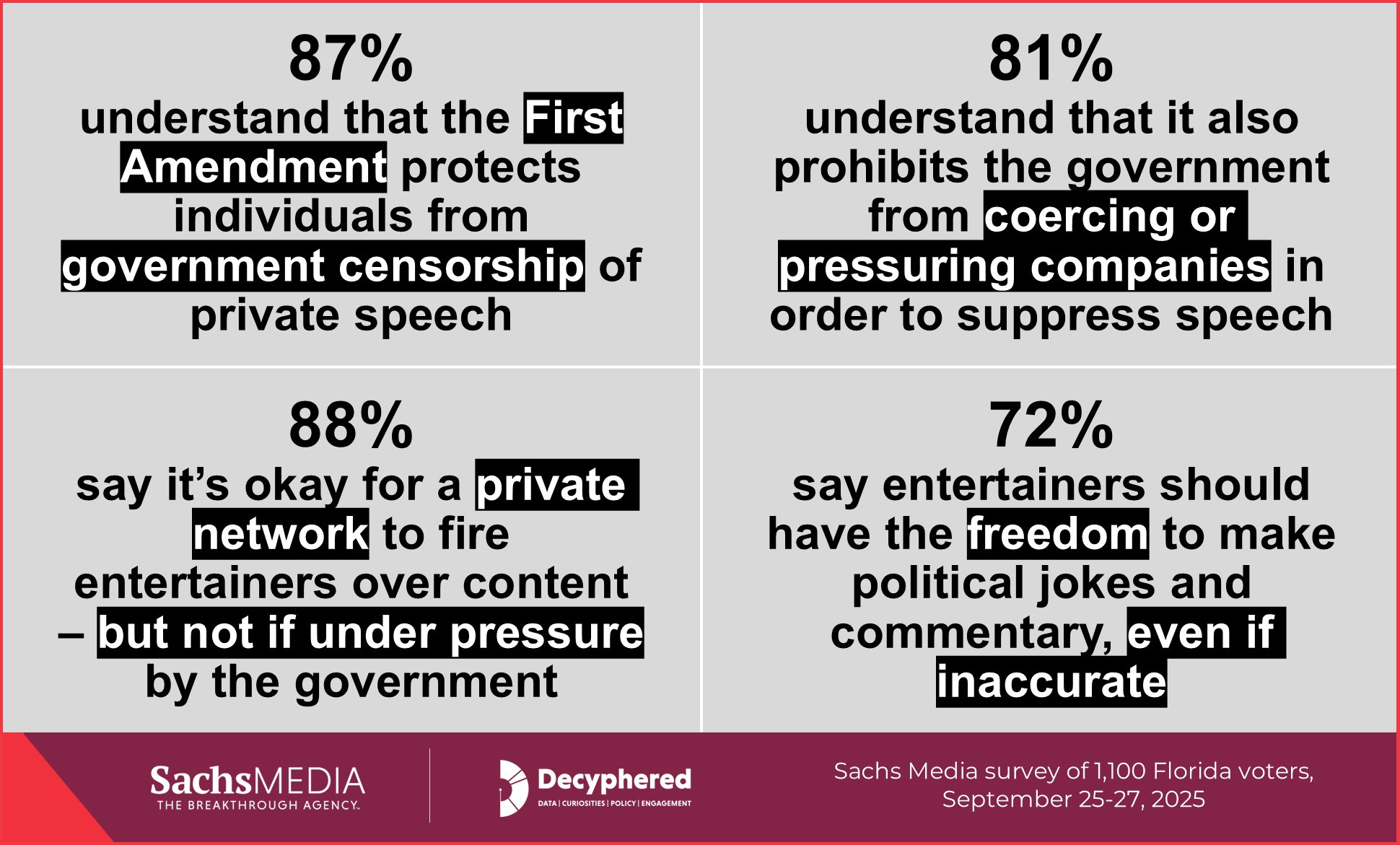
Our new, random-sample survey of 1,100 Florida voters shows that when asked what the First Amendment is intended to do, nearly 9 in 10 (87%) understand that it protects individuals from government censorship, and that it protects private companies from interference or pressure by governments relating to their speech or the speech of their employees.
Most people (81%) also agree that the First Amendment does not shield individuals from consequences imposed by private employers or organizations for their speech. Further, nearly 3 in 4 (72%) say that entertainers should have the freedom to make political jokes and commentary, even if what they say turns out to be inaccurate.
This shared instinct is crucial: It means Americans largely understand the constitutional boundary line between government interference and private decisions. And when presented with hypothetical governments and hypothetical entertainers, they broadly agree (88%) that it’s constitutional for a network to cancel a talk show host for his or her content, but not to do so under pressure by the government.
But other findings from this same survey – fielded September 25-27, 2025 – illustrate how common ground can quickly erode: When principles meet real-life politics, consensus fractures into partisan mirror images. Whether by self-selection or algorithms driving only certain types of content, America becomes starkly divided on basic facts regarding current events.
Testing free speech principles against real-life scenarios
In the last few weeks alone, two major free-speech news items hit our feeds: Jimmy Kimmel’s show was suspended from the air under what was reported as pressure from the Trump Administration; and Alphabet (the parent company of Google) executives testified to Congress that the Biden Administration pressured them to remove content that contradicted the White House’s party line. While the latter wasn’t as widely reported as Kimmel’s firing and swift return to the stage, the tech company’s account was consistent with prior admissions by Meta about censorship and strong-arming under Biden.
Despite such testimony, respondents in this latest survey split hard when asked whether the Biden Administration pressured media and social platforms to censor content: Just 14% of Democrats versus 83% of Republicans say it happened.
Similar chasms are seen regarding the Trump administration’s record on First Amendment issues. While his 2024 campaign promise to restore free speech drew broad support in Florida at the time (82% overall saw this as a worthy goal, including 68% of Democrats, 86% of NPAs, and 94% of Republicans), most don’t believe the president has fulfilled this mandate since.
Specifically, only about 1 in 4 (24%) say the Trump administration has protected and defended free speech broadly, even where they disagree with what is being said. To the contrary, more than 3 in 4 (76%) believe this administration has instead targeted critics (59%) or has applied standards unevenly to give preferential treatment to allies (16%).
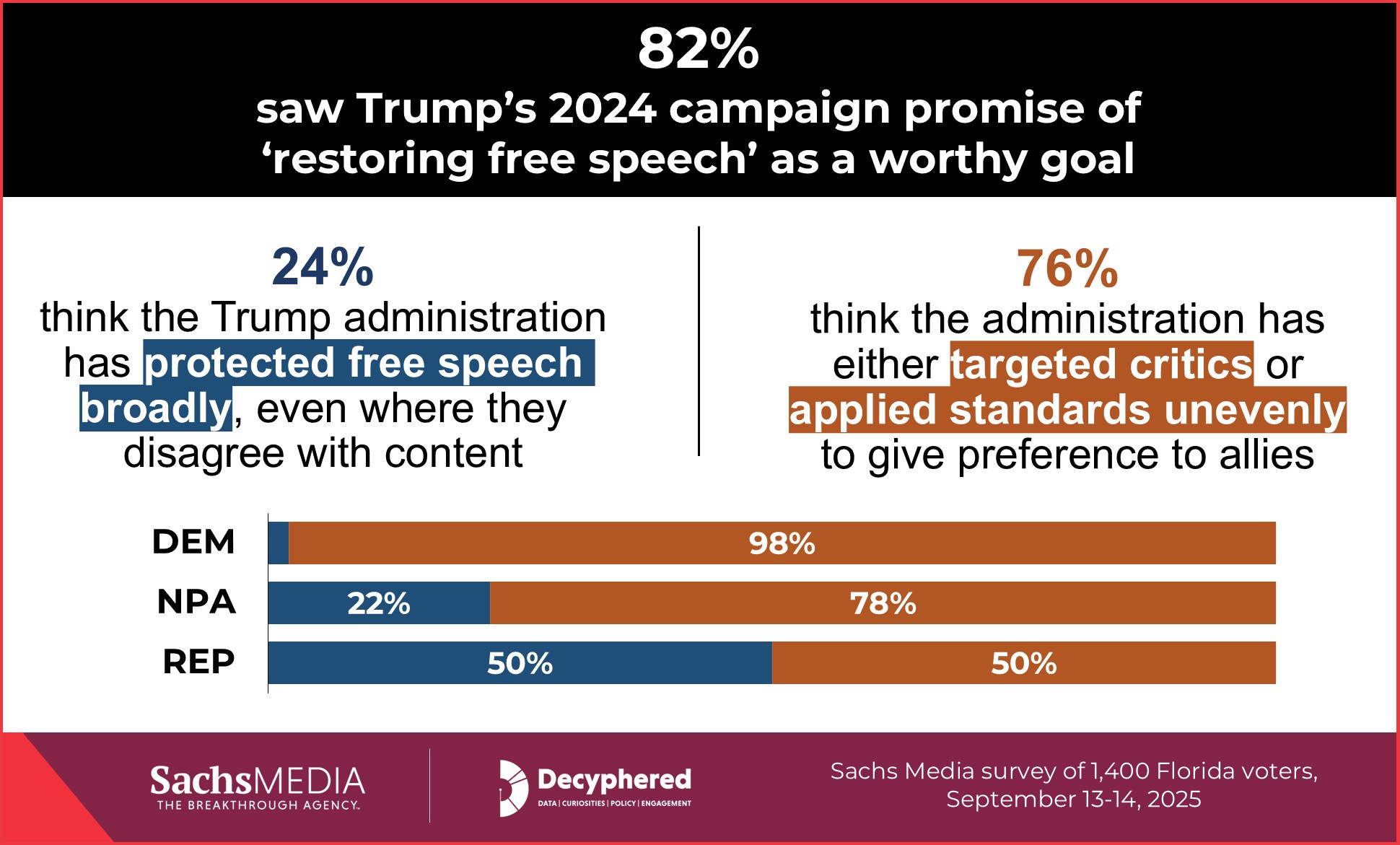
Notably, only half of Republicans (50%) believe the leader of their party has acted equitably on this issue. These results are an outlier from most other policy areas in one important respect: Far greater shares of Republican voters are critical of the Trump administration on this issue than they are on most others we’ve polled on lately.
The Kimmel moment: universal awareness, but parties break on what’s true
Nearly everyone surveyed (99%) had heard that Jimmy Kimmel was pulled off the air following comments about Charlie Kirk’s murder. But the reason they perceive behind that action is colored by party affiliation.
Kimmel made two statements that people point to as causing the network’s actions. First, he stated: “We hit some new lows over the weekend with the MAGA gang desperately trying to characterize this kid who murdered Charlie Kirk as anything other than one of them, and doing everything they can to score political points from it.”
Then, Kimmel played a clip of Trump responding to a question about his feelings following Kirk’s murder. In that clip, Trump shared news of a new White House ballroom project he had in the works. Kimmel joked that Trump was exhibiting the “fourth stage of grief: construction” and that the president’s emotional response to this loss was akin to a four-year old mourning a goldfish.
A majority overall (57%) say Kimmel was punished for making an offensive joke, while a third (33%) say it was for spreading misinformation about a criminal suspect. Democrats overwhelmingly land on “offensive joke” as the cause (85%), while Republicans are much more likely to say “misinformation” (62%).
The factual accuracy question is where the gulf really opens. Asked to judge the truth of Kimmel’s implication (that the shooter was a “MAGA” conservative), 24% say it is true, 41% say false, and 34% aren’t sure. Looking only at those who expressed an opinion on the issue, the partisan split is profound: 79% of Democrats believe Kimmel was accurate in suggesting that the shooter was a MAGA conservative – a perception shared by half as many nonpartisans (40%) and just 6% of Republicans.
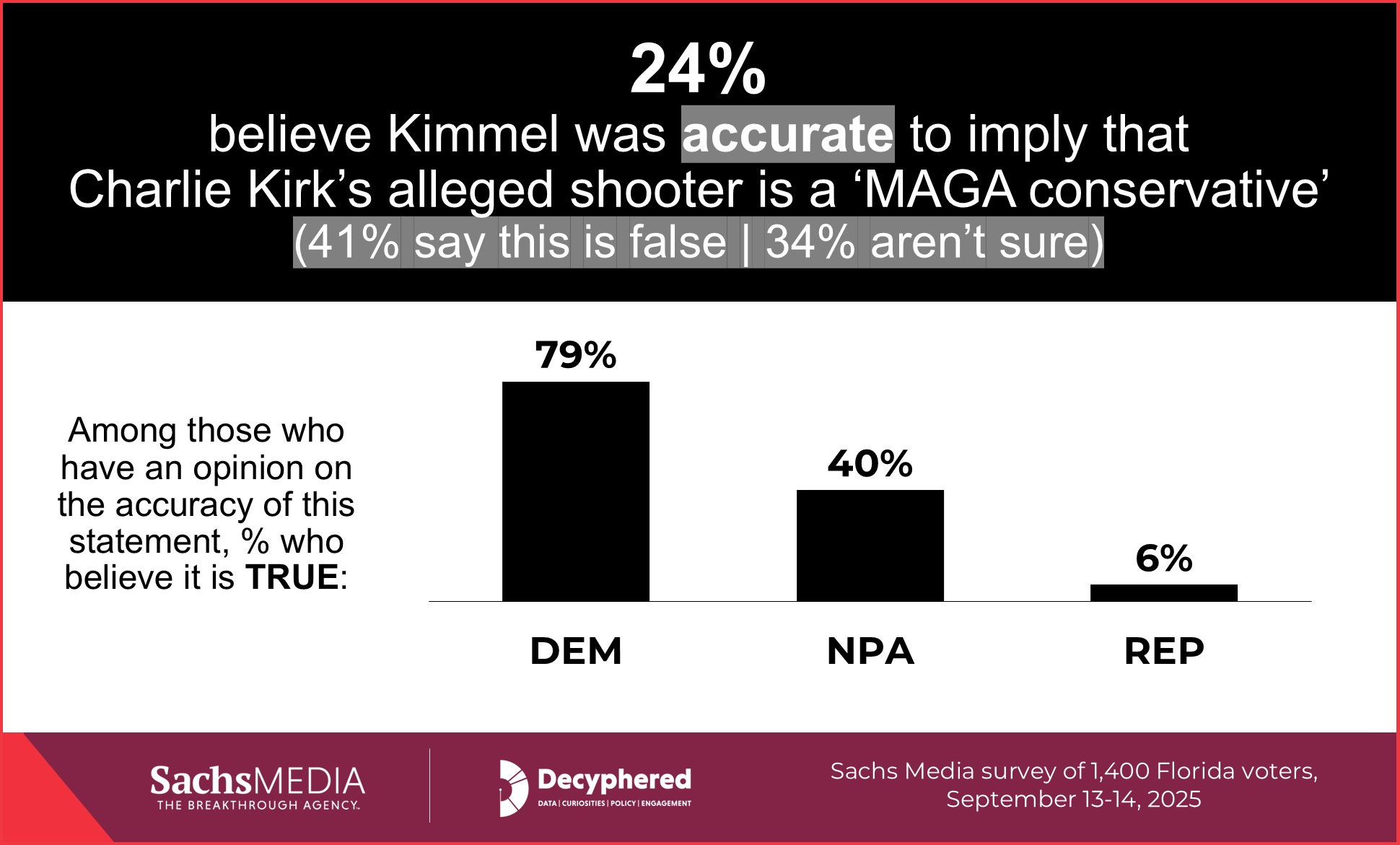
Whatever the truth may be, this is a clear demonstration of self-selection of polarized and polarizing news, social media algorithms that may drive divides by showing people more and more extreme examples of things they already agree with, and perhaps innate unwillingness to believe that people “like us” are capable of carrying out unthinkable acts.
Jokes vs. facts: where voters draw the line on consequences
Regardless of whether an entertainer tells “just a joke” or spreads “misinformation,” a minority of voters believe the person should be fired for specific speech.
Fewer than 1 in 7 (15%) say it would be totally fair to fire Kimmel for the construction/goldfish joke alone. And concerning Kimmel sharing misleading information on the political leanings of Kirk’s killer, the share who believe punishment is warranted rises to 26% overall.
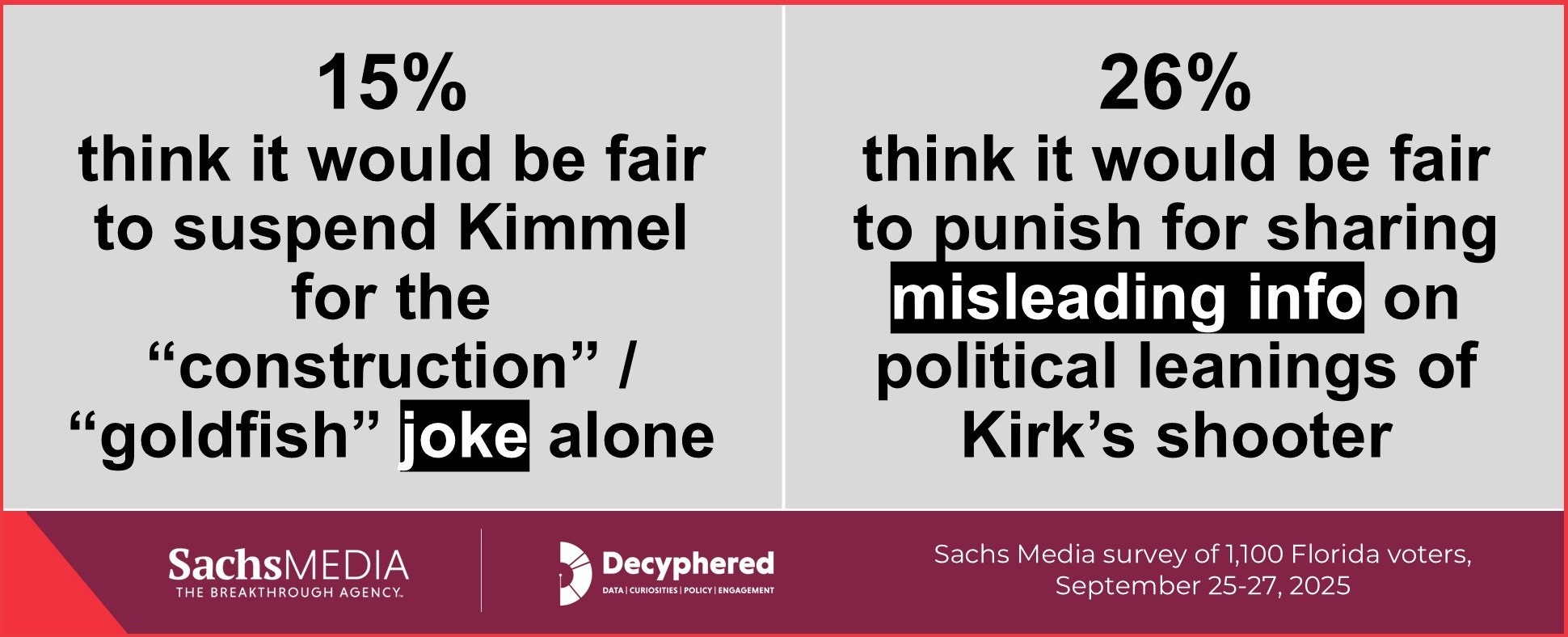
This suggests that voters do make some distinction between offensiveness and inaccuracy, and are more willing to punish the latter than the former – but importantly, the willingness to punish is fairly low regardless.
Do people think government pressure actually happened?
Despite the broad belief that the government shouldn’t pressure private companies on speech, a majority of respondents believe this did happen in the Kimmel case.
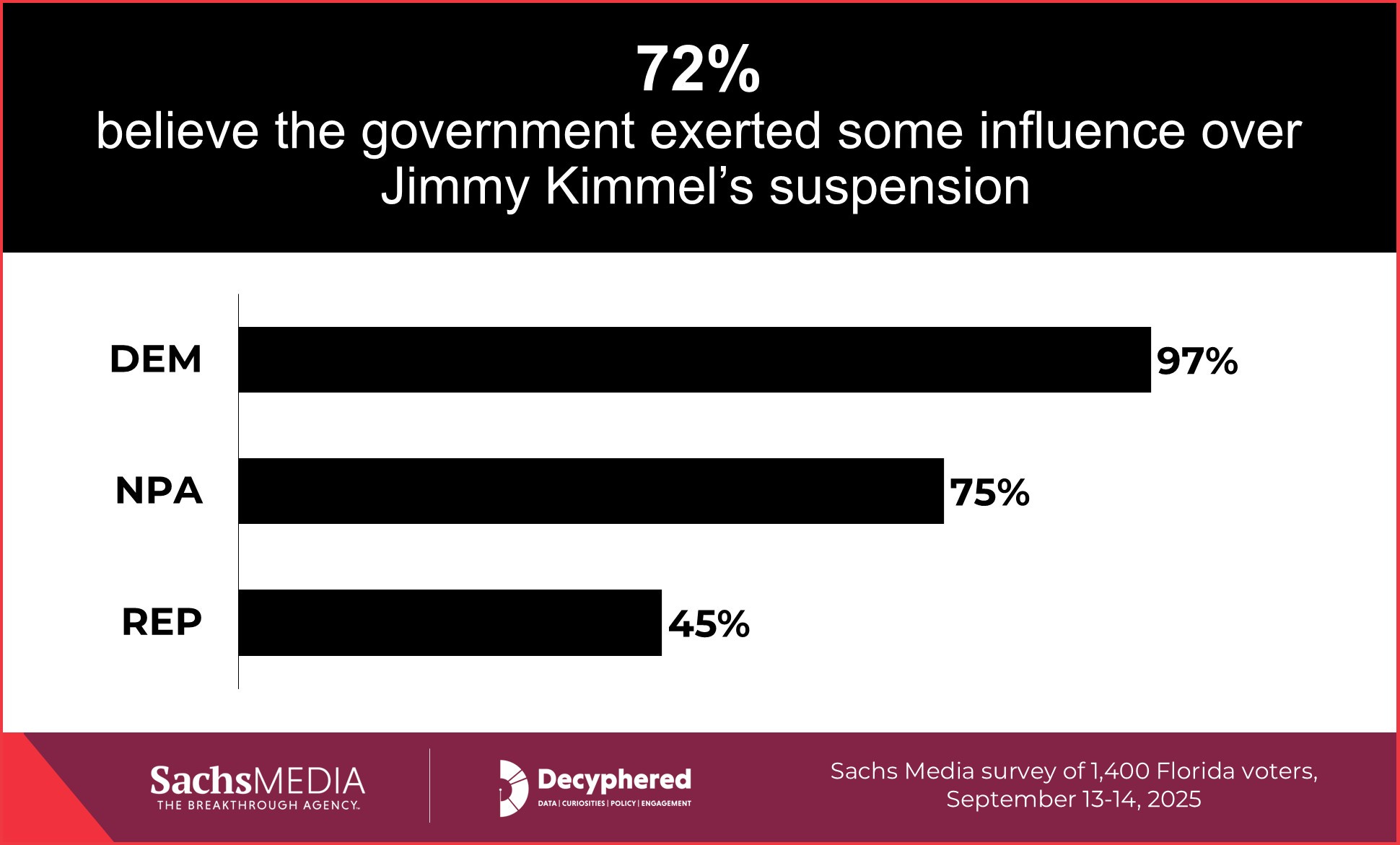
More than 7 in 10 (72%) say Kimmel’s removal resulted either from government pressure exclusively (46%) or was based on at least some government pressure, such as ABC’s desire to curry favor with the FCC in its consideration of future mergers (25%).
Nearly all Democrats (97%), three-quarters of nonpartisans (75%), and nearly half (45%) of Republicans believe the network received at least some pressure by the Trump administration.
Put in other terms, just 28% of respondents believe Kimmel’s firing was the network’s unilateral decision, void of political pressure from outside.
Chilling effects and a skeptical public
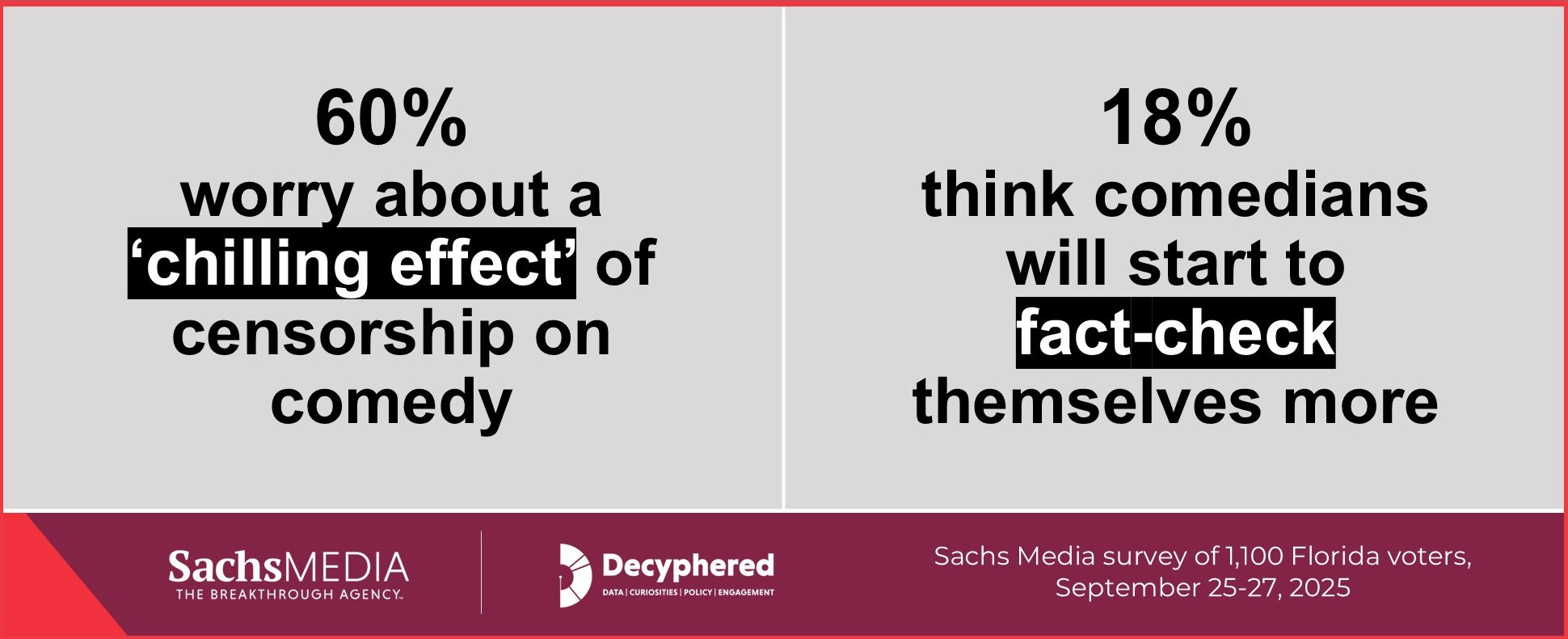
Does the Kimmel episode make people worry about a chilling effect? It does seem so. Six in ten (60%) say they’re concerned that actions like this could discourage entertainers from political commentary.
On the flip side, just 18% believe Kimmel’s firing will make entertainers more careful to fact-check before making political jokes.
A fragile consensus that reads as a warning
These findings reveal a few important realities:
Nearly all Americans still share an instinctive understanding of free speech in theory, and in the abstract condemn government interference over speech.
Americans do make a distinction between offensiveness and inaccuracy, and are more willing to punish the latter than the former – but importantly, the willingness to punish is fairly low for both.
Those instincts shift when tested against the personalities and politics of the moment. Voters selectively excuse or condemn speech (or the stifling of it) depending on who is speaking (or stifling).
Outrage is quickly filtered through partisan lenses – resulting in public opinion shaped less by facts than by the tribe we identify with.
A majority of voters believe government interference is already happening in the media space, even as they diverge wildly on when and by whom.
Taken together, these results should be read as a warning. Free speech in America is at risk not just from overreach by the government, but from a public that finds it hard to agree on what’s true, who is credible, or which values should guide the debate.
The challenge ahead is whether we can resist turning every fact or principle into a partisan weapon – which we use, when we hold such power – or instead hold leaders accountable to preserve what is dearest to us all: freedom.
Yep, you got that exactly correct. I'm constantly wondering whether there is such a thing as free speech anymore. Here's an interesting article I wrote today:
https://www.hiddentruthsbysunny.com/p/youre-not-a-revolutionary-youre-just